Maison

Blog

Blog

  • How do cable specifications impact hybrid electric vehicle performance?
    How do cable specifications impact hybrid electric vehicle performance?
    Jun 15, 2026
    You rely on the right Hybrid Electric Vehicle Cable to optimize your vehicle’s power delivery, safety, and efficiency. Cable specifications play a direct role in how your hybrid electric vehicle performs every day. The type, size, material, and insulation of each hybrid electric vehicle cable affect energy loss, heat management, and long-term durability. You can see how heat resistance, weight, and electromagnetic interference shape the efficiency and safety of every hybrid electric vehicle cable. The insulation material in a hybrid electric vehicle cable determines its temperature rating, which protects your vehicle from overheating and ensures reliability. When you choose a hybrid electric vehicle cable, you also impact the overall weight, which influences range and efficiency. The right hybrid electric vehicle cable withstands operational heat and maintains performance over time.   Hybrid Electric Vehicle Cable Types   You encounter several cable types in hybrid electric vehicles, each designed for a specific role. These cables ensure your vehicle operates safely and efficiently, even under demanding conditions. EV Battery Cables: You use these to transmit power between the battery pack and the electric systems. They handle high electrical currents and voltages, often reaching hundreds or even over 1,000 volts. EV Charging Cables: These connect your vehicle to external electrical sources. You rely on them for both home and public charging, with variations like Type 1 and Type 2 for different charging stations. Signal Cables: These manage communication between electronic control units, sensors, and actuators. You depend on them for accurate data transmission and system coordination. Hybrid Cables: These integrate multiple functionalities, such as power and signal transmission, into a single cable assembly. You benefit from reduced weight and simplified installation.   Power Cables   Power cables form the backbone of your hybrid electric vehicle’s electrical system. You find them in two main categories:   High Voltage   High voltage power cables deliver energy from the battery to the electric motor and other high-power components. You often see three large-diameter wires used for motor power, ensuring efficient energy transfer and minimizing losses. These cables must withstand high temperatures and mechanical stress during operation.   Low Voltage   Low voltage power cables supply energy to auxiliary systems, such as lighting, infotainment, and control modules. You need these cables to maintain stable performance and protect sensitive electronics from voltage fluctuations.   Signal Cables   Signal cables play a critical role in your vehicle’s communication network. They transmit control signals, sensor data, and feedback between various modules. You rely on their shielding to prevent electromagnetic interference, which ensures accurate and reliable operation of safety and performance systems.   Vibration-Proof Heat Resistant Cable   You face harsh environments in hybrid electric vehicles, including constant vibration and elevated temperatures. The Vibration-proof Heat Resistant Cable addresses these challenges by combining flexibility, durability, and superior heat resistance. You can use these cables in areas exposed to engine heat or frequent movement, which helps maintain stable charging and power delivery. Their robust construction reduces the risk of insulation failure and extends the service life of your vehicle’s wiring system. Tip: When selecting cable types for your hybrid electric vehicle, always consider the specific requirements of each application. Proper cable selection enhances charging efficiency, safety, and long-term reliability.   Electric Vehicle Charging Cables   You interact with several types of charging cables every time you connect your hybrid or electric vehicle to a charging station. Understanding the differences between these cables helps you make informed decisions about charging infrastructure and ensures your vehicle charges safely and efficiently.   Type 1 and Type 2 Cables   You often encounter Type 1 and Type 2 cables at public charging stations and home charging points. Type 1 cables use a single-phase connection, which suits many hybrid electric vehicles in North America and Japan. Type 2 cables, on the other hand, support both single-phase and three-phase charging. You find Type 2 cables as the standard across Europe, making them compatible with almost all electric vehicles and hybrid models. Type 2 cables offer flexible charging speeds, ranging from 3.7 kW up to 22 kW, which allows you to select the right charging point for your needs. The combined charging system and chademo connector also play a role in fast charging, but Type 2 remains the most widely adopted for everyday use. Here is a comparison to help you understand the differences: Feature Type 2 Chargers Type 3 Chargers Compatibility Widely compatible with almost all EVs due to the standard Type 2 socket. Limited compatibility; only a few EV models are equipped with Type 3 sockets. Charging Speed Offers power options from 3.7 kW to 22 kW, suitable for various charging needs. Capable of delivering up to 22 kW, comparable to Type 2 chargers. Adoption Standard in Europe and widely used at commercial charging stations. Limited adoption, mainly in French-speaking countries. Communication Protocol Uses IEC 61851-1 Mode 2 or Mode 3 protocol, enabling advanced features like monitoring and remote control. Uses IEC 61851-1 Mode 3 protocol, less supported by EV manufacturers. You see that Type 2 cables dominate the market due to their compatibility and charging speed. You also notice that the sae j1772 connector is common in North America, while the combined charging system and chademo connector support dc fast charging at many charging stations.   Mode 3 Charging Cables   You use Mode 3 charging cables at dedicated charging stations and charging points. These cables connect your vehicle directly to the charging infrastructure, providing advanced safety features and communication protocols. Mode 3 supports both tethered cables and untethered cables, giving you flexibility at public and private charging points. Tethered cables remain attached to the charging station, while untethered cables allow you to carry your own cable and connect to different charging stations. You benefit from Mode 3’s ability to handle dc fast charging, which reduces charging time and increases convenience.   Cable Structure and Insulation   You rely on electric vehicle charging cables with robust structure and insulation to ensure safety and performance. The insulation provides electrical isolation, which prevents shocks during charging. It also offers mechanical protection, shielding the cable from physical damage and environmental factors like UV light and moisture. High-temperature resistance materials, such as 125℃ irradiation cross-linked insulation, maintain cable integrity under the heat generated by dc fast charging. These materials also resist aging and mechanical wear, extending the lifespan of your charging cables. High-temperature resistance keeps your cables safe during dc fast charging. Aging resistance protects against UV rays and moisture at outdoor charging stations. Mechanical durability ensures reliable performance at every charging point. You can enhance your charging experience by choosing electric vehicle charging cables with advanced insulation and multi-layer design. For applications requiring even higher temperature resistance, you may consider 150°C and 200°C Fluoroelastomer wire, which delivers exceptional durability and safety for demanding charging environments.   Conductor Material   You make a critical choice when selecting the conductor material for your hybrid electric vehicle cables. The conductor determines how efficiently electricity flows, how much heat the cable generates, and how much weight your vehicle carries. Two main options dominate the industry: copper and aluminum.   Copper vs Aluminum   Conductivity   You want your cables to deliver power with minimal loss. Copper stands out for its superior electrical conductivity. Aluminum, while lighter, does not match copper’s ability to carry current as efficiently. The table below compares the two materials: Property Copper (Cu) Aluminum (Al) Conductivity (IACS) 100% ~61% Resistivity (Ω·mm²/m) 0.0172 0.0282 You see that copper offers the highest conductivity, which means less energy loss and lower heat generation. Aluminum’s higher resistivity means you need a larger cross-sectional area to achieve the same performance as copper. This difference impacts both efficiency and cable design.   Weight   You also need to consider the weight of your vehicle’s wiring. Aluminum provides a significant advantage here: Aluminum weighs about one-third as much as copper, which helps reduce the overall weight of your vehicle. Lighter wiring can improve your vehicle’s range and efficiency because less energy is required to move the vehicle. Many engineers use aluminum for busbars and certain wiring components, achieving up to 50% weight savings compared to copper. You benefit from these weight reductions, especially in hybrid electric vehicles where every kilogram counts.   Material Purity   Imagine two roads: one smooth and freshly paved, and another filled with small rocks and debris. A car can travel on both, but the smooth road allows for faster, more consistent movement. Electricity behaves the same way in conductors. High-purity materials provide a clear path for electrons, while impurities act like obstacles, increasing resistance and wasting energy. You should always look for high-purity conductor materials in your hybrid electric vehicle cables. Purity directly affects resistance. Impurities disrupt the flow of electrons, causing more heat and energy loss. Over time, this extra heat stresses the insulation, which can lead to premature wear or even electrical faults. Impurities also accelerate corrosion and fatigue, reducing the long-term reliability of your cables. Manufacturers measure purity using industry standards such as conductivity tests and chemical analysis. For example, copper conductors often come in purities like 99.90%, 99.95%, or even 99.999%. Even small differences in purity can lead to noticeable changes in conductivity, heat generation, and cable lifespan. You ensure the best performance and durability by choosing cables with the highest available purity.   Cable Size   You make critical decisions about cable size when designing or maintaining a hybrid electric vehicle. The right cable size ensures safe, efficient charging and reliable power delivery. You must consider several factors, such as conductor standards, voltage range, and the environment where the cable operates. When you select a cable for charging, you look at the working voltage, current, and temperature rise. You also compare the peak current and duration with the cable’s performance curve. This process helps you match the cable size to the demands of your charging system.   Current Capacity   You need to match the cable’s current-carrying capacity to the charging requirements of your vehicle. If you choose a cable that is too small, you risk overheating and energy loss during charging. If you select a cable that is too large, you add unnecessary weight and cost. You follow industry standards like LV216-1/2 and ISO19642 to guide your choices. These standards help you verify the working voltage, usually below 1000V DC, and select the right diameter for your charging cables.   Energy Loss   You want to minimize energy loss during charging. When you use a cable with the correct size, you reduce resistance and keep energy loss low. If the cable is too thin, resistance increases, and you lose more energy as heat. This loss affects the efficiency of your charging process and can shorten the lifespan of your vehicle’s electrical system. You always check the effective working current and ensure the cable can handle the peak current during charging.   Heat Generation   You must control heat generation in your charging cables. Excessive heat can damage insulation and reduce cable life. You select cable sizes based on temperature rise and current-carrying capacity. You also ensure that the fuse blows before the cable reaches its smoke point. This approach protects your vehicle during high-current charging events. You rely on cables with advanced insulation, such as those found in Vibration-proof Heat Resistant Cable, to withstand the heat produced during fast charging. Tip: Always monitor the temperature of your charging cables during operation. Consistent overheating signals the need for a larger cable size or improved insulation.   Impact on Vehicle Weight   You balance cable size with vehicle weight to optimize charging efficiency and performance. When you use higher voltage systems, such as 48V, you can select smaller cables for charging. These cables weigh less and use less copper than traditional 12V wires. For example: 48V charging wires have about 10% of the diameter and weight of 12V wires. Smaller charging cables reduce the overall weight of your vehicle. Lower weight improves thermal efficiency and enhances vehicle performance during charging. You see that every kilogram saved in cable weight can extend your vehicle’s range and improve charging speed. You also reduce material costs and make your vehicle more efficient. When you choose the right cable size for charging, you achieve a balance between safety, performance, and weight. You can further enhance your charging system by selecting cables with high-temperature insulation, such as 150°C and 200°C Fluoroelastomer wire. These cables maintain performance even during intense charging sessions and demanding environments.   Insulation and Heat Resistance   You depend on advanced insulation and heat resistance to ensure your hybrid electric vehicle cables perform reliably under demanding conditions. Insulation materials protect against electrical faults, mechanical damage, and environmental hazards. High-performance insulation also maintains cable integrity when exposed to elevated temperatures and vibration.   Fluoroelastomer Wire   High Temperature Performance   You encounter extreme heat in hybrid electric vehicle powertrains, especially near engines and battery packs. Insulation materials with higher temperature ratings deliver superior durability and safety. The table below compares common insulation materials used in hybrid electric vehicle cables: Property PVC TPU Irradiation Cross-Linked Max Operating Temp ~70℃ ~90℃ 125℃ continuous UV Resistance Low Medium High Flexibility at Cold Poor Good Excellent Mechanical Strength Low Medium High Environmental Compliance Halogenated Variable Halogen-Free Cost Low Medium Higher (but long-lasting) Insulation materials rated for 125°C or higher, such as irradiation cross-linked compounds, resist degradation and maintain structural integrity under high current loads. Lower-rated materials like PVC can soften and lose strength at elevated temperatures, increasing fire risk and reducing cable lifespan. You achieve even greater heat resistance with fluoroelastomer wire. AFLAS fluoroelastomers withstand temperatures up to 200°C, making them ideal for hybrid electric vehicle applications. FEPM fluoroelastomers also deliver long-term durability in high-temperature environments. These materials ensure reliability where thermal stress is constant. AFLAS fluoroelastomers operate reliably at temperatures up to 200°C. FEPM fluoroelastomers provide lasting performance in high-heat zones. Fluoroelastomer insulation remains nonflammable, supporting safety in electric and hybrid vehicles.   Durability   You require cables that last through years of operation. Fluoroelastomer wires resist chemical exposure, mechanical abrasion, and thermal cycling. Their nonflammable nature protects your vehicle from fire hazards. You benefit from their ability to maintain flexibility and insulation integrity, even after repeated heating and cooling cycles. Choose fluoroelastomer wire for critical areas where heat and durability matter most. You secure long-term reliability and reduce maintenance needs.   Vibration-Proof Features   You face constant vibration in hybrid electric vehicles, especially near motors and suspension systems. Vibration-proof features protect cable integrity and prevent insulation failure. Hoonsun seals provide effective vibration damping and exceptional resistance to high temperatures. These seals offer excellent cable management and structural protection, which are essential for maintaining performance under vibration. Secondary locking features enhance vibration resistance. Sealing gaskets deliver environmental protection (IP67+), ensuring durability. Shielded, compact connectors maintain signal integrity during high-vibration operation. Flexible cable materials like silicone and advanced TPE blends withstand frequent movement and vibration. Spiral and recoilable cable designs offer shape memory and elastic recovery, further improving vibration resistance. You maintain cable integrity by selecting cables with robust vibration-proof features. These designs ensure stable performance and reduce the risk of electrical faults. For the most demanding environments, you can rely on 150°C and 200°C Fluoroelastomer wire to deliver unmatched heat resistance and durability. This choice supports optimal performance and safety in hybrid electric vehicles.   EV Charging Connectors   You interact with ev charging connectors every time you charge your hybrid electric vehicle. These connectors serve as the critical link between your vehicle and the charging station. The right connectors ensure that energy flows safely and efficiently, supporting the overall performance of your vehicle. When you select a Hybrid Electric Vehicle Cable, you also need to consider the compatibility and quality of the connectors attached to it.   Connector Quality   The quality of ev charging connectors directly affects the reliability and safety of your charging system. High-quality connectors provide a secure and stable connection, which is essential for efficient energy transfer.   Secure Connections   You depend on connectors to create a solid link between the charging cable and your vehicle. The control module checks the connectors before charging begins. If the connectors do not latch properly, the system will disable the connection to prevent risks such as arcing or overheating. This process protects you and your vehicle from dangerous situations. Reliable connectors also help maintain a consistent flow of electricity, reducing the chance of interruptions during charging. Connectors play a crucial role in the charging process by ensuring proper attachment. The system checks connectors for readiness before allowing energy transfer. If a latch slips or a connector fails, the system stops charging to prevent hazards.   Maintenance   You need to maintain your ev charging connectors to ensure long-term performance. Regular inspection helps you spot signs of wear, corrosion, or damage. Clean connectors allow for better contact and reduce resistance, which improves charging efficiency. If you notice any issues, replace the connectors promptly to avoid safety risks. Using a Vibration-proof Heat Resistant Cable can also help, as these cables and their connectors withstand harsh environments and frequent use. Inspect connectors for physical damage or corrosion. Clean connectors regularly to maintain optimal contact. Replace worn or damaged connectors to ensure safety.   Impact on Performance   The performance of your hybrid electric vehicle depends on the quality and condition of the ev charging connectors. These connectors form part of the Electric Vehicle Supply Equipment (EVSE), which includes cables and protective devices. EVSE ensures standardized and safe energy transfer between the power source and your vehicle. Rigorous testing and compliance with industry standards guarantee that connectors deliver reliable performance. When you use high-quality connectors, you experience faster charging times and fewer interruptions. Poor-quality connectors can cause energy loss, overheating, or even system failure. You should always choose connectors that meet strict safety and durability standards. For demanding environments, consider using 150°C and 200°C Fluoroelastomer wire with compatible connectors to achieve the best results. Tip: Always match your connectors to your vehicle’s requirements and charging environment. This practice ensures optimal performance and extends the lifespan of your charging system.   Performance Concerns   Energy Efficiency   You strive for maximum energy efficiency in every hybrid electric vehicle. Cable specifications play a crucial role in how efficiently your vehicle transfers power during charging and operation. When you select cables with high conductivity and optimal size, you minimize energy loss. Copper conductors deliver superior performance, but you must balance weight and flexibility. Aluminum offers lighter alternatives, yet requires larger diameters to match copper’s efficiency. You also need to consider insulation materials. Advanced insulation reduces resistance and prevents unnecessary heat buildup. When you use cables with high-purity conductors and robust insulation, you ensure that more energy reaches the motor and battery, rather than dissipating as heat. This approach improves your vehicle’s range and reduces charging time. Tip: Always match cable specifications to your vehicle’s charging requirements. Proper selection enhances energy efficiency and supports faster charging cycles.   Heat Management   You face significant heat management challenges when operating hybrid electric vehicles. Cable selection directly impacts how well your vehicle handles thermal stress during charging and high-power operation. Common challenges include: Managing heat exposure in cables near battery packs and motors Selecting appropriate insulation materials for high-temperature zones Ensuring flexibility and durability under continuous thermal stress You must choose insulation materials rated for the expected temperature range. Here is a comparison of common insulation types and their temperature ratings: Insulation Material Max Operating Temperature PVC 90° to 105°C Thermoplastic Polyurethane (TPU) Up to 125°C Cross-linked Polyethylene (XLPE) Up to 125°C Irradiation XLPE Up to 150°C Silicone & Cross-linked Fluoroelastomers (XLFEs) Up to 200°C You rely on advanced insulation materials to improve heat management. Ceramic fiber holds a significant share of the electric vehicle insulation market due to its exceptional heat resistance and fire protection. Silicone rubber offers flexibility and strong thermal resistance, supporting long service life and enhancing safety in high-voltage environments. Thermal interface materials improve thermal conductivity, preventing overheating in battery packs and power electronics. When you select cables with high-temperature insulation, such as 150°C and 200°C Fluoroelastomer wire, you protect your vehicle from thermal events and ensure reliable charging performance. These materials withstand extreme heat and maintain structural integrity, supporting critical safety features. Note: Effective heat management extends cable lifespan and reduces maintenance needs. Always verify insulation ratings before installing cables in high-temperature areas.   Durability   You demand durability from every cable in your hybrid electric vehicle. Environmental factors such as temperature, vibration, humidity, and mechanical stress challenge cable longevity. Industry standards, including ISO 16750-3 and ISO 16750-4, address mechanical and climatic loads. These standards require cables to withstand vibration, mechanical shock, humidity, dust, corrosion, and ice. You encounter combined humidity and vibration tests that simulate real-world conditions. Temperature testing ranges from -45°C to 50°C, with higher thresholds for cables near engines or exposed to sunlight. Environmental tests verify cable effectiveness and safety at both vehicle and subsystem levels. You achieve greater durability by selecting cables with robust insulation and vibration-proof features. Flexible materials, such as silicone and fluoroelastomers, maintain performance under repeated movement and thermal cycling. When you use cables like Vibration-proof Heat Resistant Cable, you ensure stable charging and protect against insulation failure. Tip: Choose cables tested for vibration and climatic loads. This practice guarantees long-term durability and supports essential safety features in hybrid electric vehicles.   Safety   You must prioritize safety when selecting cables for hybrid electric vehicles. The right Hybrid Electric Vehicle Cable protects you from electrical hazards and ensures your vehicle operates reliably in all conditions. Industry standards require cables to pass rigorous tests before they reach your vehicle. These tests confirm that each cable can withstand the harsh environments and high voltages found in modern hybrid systems. Testing Category Purpose Thermal Aging Tests Evaluate material performance after prolonged heat exposure (e.g., 125°C for 3,000+ hours). Dielectric Breakdown & Insulation Resistance Tests Measure resistance to electrical breakdown at high voltages (1,000V to 5,000V). Flame Propagation Tests Ensure materials do not contribute to fire spread or emit toxic smoke (IEC 60332-1, UL 94). Cold Flexibility and Abrasion Tests Assess durability in winter conditions and during vibrations. Chemical Resistance Testing Simulate exposure to various automotive fluids. Water Spray and Condensation Tests Critical for cables routed underfloor or near HVAC systems. You depend on these tests to guarantee that your vehicle’s wiring will not fail under stress. For example, flame propagation tests ensure that cables do not spread fire or release harmful smoke. Dielectric breakdown and insulation resistance tests confirm that cables can handle high voltages without shorting or leaking current. Cold flexibility and abrasion tests check that cables remain durable during winter driving and constant vibration. Automotive engineers also use advanced systems to monitor cable integrity. The High Voltage Interlock Loop (HVIL) checks the condition of high-voltage modules, cables, and connectors. This system powers down the high-voltage circuit if it detects a fault. HVIL prevents electric shock by ensuring that voltage levels are safe before you or a technician can touch any components. You benefit from this automatic protection every time you drive or service your vehicle. HVIL monitors the entire high-voltage system for faults. It disconnects power instantly if a problem appears. You avoid electric shock because HVIL ensures safe voltage levels before contact. You should also consider the cable’s ability to resist fire, chemicals, and water. Hybrid vehicles often operate in challenging environments, such as wet roads or near engine compartments. A Vibration-proof Heat Resistant Cable provides extra protection against heat, vibration, and moisture. This type of cable maintains its structure and insulation even when exposed to harsh conditions, reducing the risk of short circuits or fire. When you select cables with high-quality insulation, you further improve safety. Materials like 150°C and 200°C Fluoroelastomer wire offer outstanding resistance to heat and chemicals. These wires do not burn easily and do not emit toxic smoke, which helps protect you and your passengers in the event of a fire. You can trust these advanced materials to keep your vehicle’s electrical system secure and reliable. Tip: Always choose cables that meet or exceed industry safety standards. This decision protects you, your vehicle, and everyone on the road.   You drive performance, safety, and reliability by selecting the right cable specifications for hybrid electric vehicles. You optimize charging efficiency with advanced conductor materials and precise cable sizing. You improve charging safety by using insulation that withstands heat and vibration. You benefit from innovations like thermally conductive insulation, nanomaterial-enhanced conductors, and smart cables that monitor charging conditions. You rely on co-extrusion techniques for compact cable designs and enhanced charging durability. You achieve optimal charging operation by prioritizing cable quality in every charging system. You secure long-term charging reliability with 150°C and 200°C Fluoroelastomer wire.       FAQ What makes a Hybrid Electric Vehicle Cable different from standard automotive cables? You use a Hybrid Electric Vehicle Cable because it handles higher voltages and currents. This cable supports efficient charging, resists heat, and ensures safety. Standard automotive cables cannot meet the demands of hybrid systems or advanced charging requirements. How do I choose the right cable for fast charging? You select cables rated for your vehicle’s maximum charging current and voltage. Look for robust insulation and heat resistance. Fast charging generates more heat, so you need cables that maintain performance and safety during rapid charging cycles. Why is insulation important for charging cables? Insulation protects you from electric shock and prevents short circuits during charging. It also shields the cable from heat and environmental damage. High-quality insulation ensures your charging system remains safe and reliable, even under heavy use. Can vibration affect charging cable performance? Yes, vibration can cause wear and insulation failure over time. You reduce this risk by using a Vibration-proof Heat Resistant Cable. This cable maintains stable charging performance, even in areas exposed to constant movement or engine vibration. What temperature rating should I look for in charging cables? You should choose cables with a temperature rating that matches your vehicle’s charging environment. For demanding applications, 150°C or 200°C ratings offer superior protection. 150°C and 200°C Fluoroelastomer wire ensures your charging cables withstand extreme heat. How often should I inspect my charging cables? You should inspect your charging cables regularly for signs of wear, damage, or corrosion. Frequent checks help you catch problems early and maintain safe charging. Replace cables immediately if you notice any defects. Do cable connectors impact charging efficiency? Yes, connectors play a key role in charging. Secure, high-quality connectors ensure stable current flow and reduce energy loss. Poor connectors can cause overheating or interruptions during charging, so always use connectors that match your cable and vehicle requirements. Are there standards for charging cable safety? You benefit from industry standards that set requirements for charging cable safety. These standards cover insulation, heat resistance, and durability. Following them ensures your charging cables deliver reliable performance and protect you during every charging session.
    EN SAVOIR PLUS
  • What Are The Key Cable Types For Electronic Products And Their Practical Applications?
    What Are The Key Cable Types For Electronic Products And Their Practical Applications?
    Jun 09, 2026
      You often work with electronic devices that require different c ables for power, charging, and data transfer. The most Useful Cables include: USB-C to USB-A Cable – Connects modern devices to older computers or chargers. Multi-Charging Cable – Supports USB-C, Lightning, and Micro USB for versatile charging. HDMI Cable – Delivers high-quality audio and video between devices. Micro USB Cable – Powers and syncs many small electronics. USB-C to HDMI or DisplayPort Cable – Links devices to external displays. Lightning Cable – Charges and syncs Apple devices. Knowing the most useful cables helps you pick the right cable for your specific device and application. Key Takeaways Choose cables based on device compatibility and performance needs. Use shielded cables to minimize interference in high-EMI environments. Select fiber optic cables for high-speed and long-distance data transfer. Most Useful Cables for Electronics Essential Cable Types Overview You interact with many cable types when working with electronic products. Industry experts highlight these as the most useful: Power cord: Delivers electricity to computers, monitors, and appliances. HDMI cable: Transfers high-definition video and audio for multimedia devices. USB cable: Connects and powers smartphones, tablets, and laptops. Audio cable: Sends sound signals to headphones, speakers, and sound systems. Charging cable: Powers portable electronics and wearables. The table below shows the main uses for each essential cable type: Cable Type Main Uses Power Cord Computers, monitors, printers, household appliances, portable electronics HDMI Cable TVs, projectors, gaming consoles, home theater systems USB Cable Smartphones, tablets, laptops, external hard drives, printers Audio Cable Headphones, speakers, professional sound systems, home theater setups Telephone Cable Landline phones, DSL internet, intercom systems Charging Cable Smartphones, tablets, laptops, wearable devices Choosing the Right Cable You need to consider several factors when choosing the right cable for your device. Start by checking protocol support and speed ratings. Look for clear labels such as “USB 3.2 Gen 2” or “HDMI 2.0” to match your performance needs. Pay attention to cable length, as longer cables can reduce signal quality. Select cables with strong build quality and strain relief to prevent damage. Certification and compatibility matter for safety and reliability. Environmental conditions, such as heat or interference, also affect your choice. In high-temperature sensing or control applications, a High Temperature Sensor Cable can help maintain stable performance. For network connections, always use cables that meet the latest standards to ensure stable performance. By focusing on these criteria, you make choosing the right cable simple and effective for any application. Power Cable Types Standard Power Cables You encounter standard power cables every day when you use computers, monitors, and office equipment. The IEC C13/C14 cable is one of the most common choices for these devices. The C13 connector plugs into your device, while the C14 connects to the power source. This cable supports up to 10 Amps and 240V, making it safe for a wide range of electronics. Detachable power cords, also called line cords, offer flexibility because you can easily replace them if damaged. Always check the voltage and amp ratings, connector type, and certifications before selecting a cable for your device. Testing and validation are critical to ensure cable assemblies meet performance requirements. Electrical tests like continuity and insulation resistance confirm operational integrity, while mechanical tests verify durability under physical stress. Environmental tests assess performance in challenging conditions, ensuring reliability in various applications. The National Fire Protection Association (NFPA) maintains standards that impact cable selection, particularly regarding fire safety. NFPA 70 sets baseline requirements for flame resistance, while NFPA 262 evaluates flame propagation height. Fire alarm cables must comply with NFPA 72 to ensure functionality during a fire. Specialized standards like NFPA 79 for industrial machinery and NFPA 99 for healthcare facilities dictate specific cable requirements relevant to their applications. UL certifications ensure safety benchmarks like fire resistance and insulation performance. RoHS compliance ensures no hazardous materials are used in cable designs. Specialty Power Cables For demanding environments, you need specialty power cables that deliver advanced performance. The ARX-9 FRW Cable and High Tensile Flexible NBR EPDM Rubber Cable stand out for their durability and resistance to harsh conditions. The table below highlights their key characteristics: Characteristic ARX-9 FRW Cable High Tensile Flexible NBR EPDM Rubber Cable Temperature Range -40 to 200°C Suitable for wet and dry environments Short Circuit Overload Up to +300°C Not specified Current Carrying Capacity High Not specified Resistance High resistance to thermal pressure, chemicals, hydrolysis, and weathering Not specified Flame Retardant Yes (UL VW-1, FT4, FT6) Not specified Flexibility Flexible minimum outer diameter Not specified Applications Motor winding, pump cables, marine and industrial applications General use in wet and dry environments You can also choose the CITCABLE Flexible Fluoropolymer Cable for projects that require exceptional weather, heat, and chemical resistance. This cable performs reliably in automotive, marine, and industrial machinery, even in extreme conditions. When you select a specialty cable, always match its features to your application for maximum safety and performance. Data and Network Cables Ethernet and Network Cables You rely on ethernet cables to build a stable and fast network for your devices. These cables connect computers, routers, switches, and servers, forming the backbone of most wired networks. You find several categories, such as Cat5e, Cat6, Cat6a, Cat7, and Cat8, each offering different speeds and shielding levels. Ethernet cables support high-speed data transfer, reduce interference, and ensure reliable communication for home and office internet, gaming consoles, and smart TVs. Tip: Choose a cable category that matches your speed requirements and device compatibility. Here is a comparison of popular ethernet cable types: Cable Type Max Data Transmission Max Bandwidth (MHz) Max Distance Cat5e 1 Gbps 100 MHz 100m Cat6 10 Gbps (up to 55m) 250 MHz 100m (1 Gbps) Cat6a 10 Gbps 500 MHz 100m Cat7 10 Gbps 600 MHz 100m Cat7a 40 Gbps (limited distance) 1,000 MHz 30m Cat8 40 Gbps 2,000 MHz 30m You use network cables for structured connectivity in IT infrastructure, data centers, and video conferencing. Fiber optic cables also play a role in high-speed data transmission, especially for long distances and environments with electromagnetic interference. USB Cable Types You encounter several USB cable types when connecting peripherals and charging devices. Each type serves a specific purpose: USB Type-A: Standard connector for PCs and laptops. USB Type-B: Used for printers and some external drives. USB Mini-B: Found in older cameras and early smartphones. USB Micro-B: Common in Android phones and portable electronics. USB Type-C: Modern, reversible connector for fast data and power delivery. The table below summarizes the main differences between USB versions: USB Version Speed/Transfer Rate Power Max Cable Length USB 1.1 12 Mbit/s N/A 3 Meters USB 2.0 480 Mbit/s 5V, 1.8A 5 Meters USB 3.0 5 Gbit/s 5V, 1.8A 3 Meters USB 3.1 10 Gbit/s 20V, 5A 3 Meters USB 4.0 40 Gbit/s 100W N/A You benefit from USB Type-C’s versatility, which supports both high-speed data transfer and power delivery for modern devices. Audio and Video Cable Types HDMI and DisplayPort Cables You often use hdmi cables and dvi cables to connect your devices for high-quality video and audio. Hdmi cables work with TVs, monitors, projectors, gaming consoles, and home theater systems. DisplayPort cables provide another option, especially for professional and gaming setups. Both hdmi and DisplayPort support high resolutions and refresh rates, but their features differ. The table below compares the main specifications of hdmi and DisplayPort cables: Specification HDMI 2.0 HDMI 2.1 DisplayPort 1.4 DisplayPort 2.0 Bandwidth 18 Gbps 48 Gbps 32.4 Gbps 77.37 Gbps Resolution 4K at 60Hz 4K at 120Hz, 8K at 60Hz 4K at 120Hz, 8K at 60Hz 8K at 120Hz, 16K at 60Hz Multi-Monitor Limited Limited Supports MST Supports MST VRR Support Yes Yes Yes Yes G-SYNC Support No No Yes Yes Hdmi cables are more common in consumer electronics, while DisplayPort excels in multi-monitor setups. Dvi and dvi cables still appear in older monitors and projectors, but hdmi cables offer broader compatibility and advanced features. Audio Cables You rely on audio cables to connect headphones, speakers, and sound systems. The most common types include 3.5mm, RCA, and XLR cables. Each cable type serves a unique purpose in audio setups. Cable Type Key Features Applications 3.5mm Versatile, widely used, compatible with various devices Headphone connection, auxiliary input, gaming headsets, home theater systems RCA Two connectors (red and white), bridges different audio devices Connecting DACs to amps, DJ equipment, older audio gear XLR Locking mechanism, rubber insulation, clear signal transmission Microphones, PA systems, stage speakers, DMX lights You should choose the right cable based on your device and sound quality needs. Hdmi cables can also transmit audio, making them a flexible choice for home theaters. Coaxial Cable Types TV and Internet Applications You rely on coaxial cables for many home and business electronic setups. These cables play a vital role in delivering television and internet services. Most TV and internet installations use coaxial cables with a 75-ohm impedance. RG-6 and RG-59 are the most common types for transmitting audio and video signals. RG-6 stands out for high-definition and ultra-high-definition content because it offers lower signal loss over longer distances. Tip: Choose RG-6 for modern TV and internet connections to ensure the best signal quality. You will find coaxial cables in several applications: Cable television connections Broadband internet service from your provider CCTV surveillance systems Satellite and antenna installations The table below highlights the main types of coaxial cables and their uses: Cable Type Impedance Application RG-6 75 Ohm Cable TV, Satellite, Internet Modem RG-11 75 Ohm Long-distance video, CATV systems RG-8 50 Ohm Amateur radio, Ethernet Coaxial cables use multiple shielding layers to block electromagnetic interference. This design keeps your signal strong and reliable, even in environments with electrical noise. The durable construction resists physical damage and environmental wear, so you can count on long-term stability. You also benefit from the ability to support TV, internet, and phone services with a single cable, which simplifies your wiring setup. Fiber Optic Cable Applications High-Speed Data Transmission You rely on fiber to achieve rapid and reliable data transfer in modern electronic systems. Fiber optic cables use light pulses instead of electrical signals, which allows you to move information at speeds up to 800 Gbps. This technology supports greater bandwidth, so you can transfer large files and stream high-definition content without delays. The table below compares fiber and copper cables: Feature Fiber Optic Cables Copper Cables Data Transmission Method Light pulses Electrical signals Speed Up to 800 Gbps Slower speeds Bandwidth Greater bandwidth, more data Limited bandwidth Electromagnetic Interference Immune to interference Susceptible to interference Distance Up to 100 kilometers without signal loss Limited to 100 meters without repeaters Corrosion Non-metallic, no corrosion Prone to corrosion You benefit from fiber’s immunity to electromagnetic interference, which keeps your signal clear even in noisy environments. A single fiber connection can transfer an HD movie in less than a tenth of a second. Copper cables would take much longer and may lose data quality. Industrial and Communication Uses You see fiber used in a wide range of industries and communication systems. Fiber optic cables enable high-speed internet and real-time communications for telecommunications. Data centers depend on fiber to connect servers and storage devices, ensuring fast and reliable access. Cable television providers use fiber to transmit high-definition signals without distortion. Military operations rely on fiber for secure and interference-resistant communication. Medical imaging systems and industrial automation also use fiber to inspect hard-to-reach areas and transmit data safely. Fiber optic cables offer numerous advantages over copper cables, including greater bandwidth and higher speed, as well as immunity to electromagnetic interference. You find fiber in transportation systems, powering real-time data monitoring for traffic control and safety. The medical industry uses fiber for high-resolution imaging techniques like endoscopy and laser surgery. Industrial automation benefits from fiber’s ability to transmit data in environments with high interference, ensuring safety and reliability. Specialty and Industrial Cables Flexible Fluoropolymer Cable Uses You often face harsh conditions in industrial, automotive, or marine environments. In these demanding settings, you need a solution that stands up to extreme temperatures, aggressive chemicals, and constant mechanical stress. The CITCABLE Fluoroelastomer Wire Cable delivers outstanding performance in these scenarios. Its fluoropolymer jacket resists acids, solvents, UV rays, and ozone, so you can rely on it for long-term durability. This cable maintains flexibility and electrical insulation even when exposed to high heat or plasma, making it ideal for motor winding, pump systems, and heavy machinery. You benefit from advanced shielding options, such as braided and foil shields, which protect against electromagnetic interference and maintain signal integrity. Many industries, including offshore energy, transportation, and large-scale construction, depend on specialty cables for power distribution, signaling, and data transfer. You can request a Customized Special Cable to match your specific needs, whether you require a particular bend radius, tensile strength, or insulation rating. Note: Specialty cables often include features like synthetic armoring, corrosion barriers, and fire-resistant jackets to ensure safety and compliance with industry standards. When you choose a flexible fluoropolymer cable, you gain a reliable solution that meets the highest standards for performance and environmental endurance. This approach ensures your equipment operates safely and efficiently, even in the most challenging conditi ons. How to Choose Cable Types Performance and Compatibility You need to match your cable selection to the performance demands of your devices and your networking environment. Always select cables that meet or exceed the requirements outlined in your device’s SMART documentation. Use cables that have been tested for compliance with connection standards to ensure a reliable connection. Choose products from reputable manufacturers to guarantee consistent quality. Keep your cables as short as possible to reduce signal degradation, especially in high-speed network connection setups. Look for cables with end-to-end shielding to minimize electromagnetic interference, which is critical for stable data communication and networking. Flexible and durable cables will support frequent movement and long-term use in internet and data applications. Select cables that match your device’s speed and bandwidth needs. Use shielded cables for environments with high electromagnetic interference. Choose fiber optical cables for high-speed internet and long-distance data transfer. Prioritize flexibility and durability for industrial or mobile networking. Safety Considerations You must consider safety when choosing cables for internet, data, and networking systems. Proper insulation and wire gauge prevent electrical failures. Environmental factors such as temperature, chemical exposure, and mechanical stress affect cable performance. EMI shielding maintains signal integrity in sensitive data communication and fiber optical cables. Select connectors and termination techniques based on durability and application needs. Compliance with industry standards ensures safety and reliable operation. Testing and validation confirm that your cables meet performance and durability requirements for internet and networking. Tip: Always verify that your cables carry the necessary certifications for your region and application. You improve device performance, safety, and reliability when you understand cable types and their uses. Proper cable selection prevents overheating, short circuits, and signal loss. Quality cables with fire-retardant insulation and correct sizing reduce risks. Factor Description Documentation Keep records for future cable selection and verification. Use this guide as your reference for every cable decision. FAQ What is the difference between usb-c and usb-a cables? You use usb-c for modern devices because it supports faster charging and data transfer. Usb-a remains common for older computers and accessories. Both types serve different connection needs. When should you choose a usb-c to usb-c cable or a usb-c to usb-a cable? You select a usb-c to usb-c cable for charging and syncing between two usb-c devices. You pick a usb-c to usb-a cable when connecting a usb-c device to a usb-a port. Can you use usb-c for all your devices? You can use usb-c with most new smartphones, tablets, and laptops. Usb-c offers universal compatibility, but some older devices still require usb-a or other connectors. ```
    EN SAVOIR PLUS
  • What Is Viton (Fluoroelastomer) Cable? Key Benefits and Industrial Uses
    Jun 04, 2026
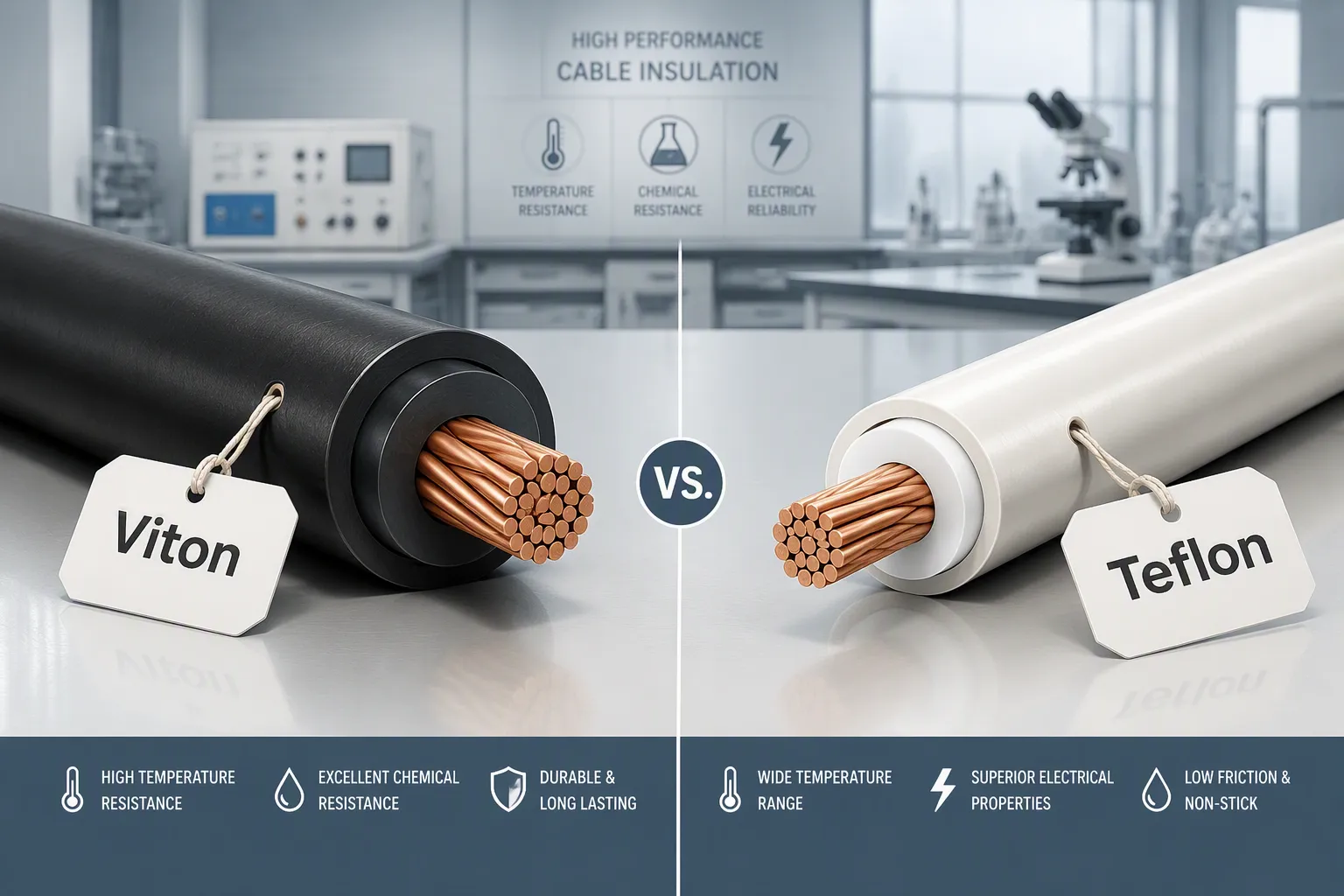
    You use viton cable when you need strong protection. It works well in tough places. Viton o-rings have a fluoroelastomer base. This base gives them special benefits. The fluoroelastomer in viton cable can handle high heat. It also protects against chemical and heat damage. Viton o-rings are different because they resist oils and fuels. They also resist strong solvents. This helps them work well in hard jobs. You find viton o-rings in planes, cars, and chemical plants. Viton cable stays strong in high heat and harsh chemicals. Viton o-rings and viton cable last a long time. The fluoroelastomer keeps them strong in tough spots. Property Description Chemical Resistance Stays safe from oils, fuels, strong solvents, and harsh chemicals. Heat Resistance Works in heat up to 250 °C. Fuel Resistance Great for seals and gaskets near fuels in planes and cars. Application Areas Used in planes, cars, chemical, oil, and electric jobs.   Key Takeaways Viton cable gives strong protection from heat and chemicals. This makes it good for hard environments. - Pick Viton o-rings when you need to seal with oils, fuels, or strong solvents. They help make sure the seal works well. - Viton can handle high heat up to 250°C. It stays strong in very hot places. - People use Viton in oil and gas, airplanes, and chemical factories. It works well for a long time in these jobs. - Always check if Viton fits and works with your needs. This helps the seal work best and stops leaks.   Viton Cable Overview Viton Composition and Structure Viton is a kind of fluoroelastomer. This makes viton o-rings and cables work well. Viton is made from four main monomers. Each monomer helps viton o-rings do better in hard places. The table below shows what each monomer does for viton. Monomer Contribution to Performance Vinylidene Fluoride (VDF) Makes the main chain of the polymer. It helps viton resist chemicals and heat. Hexafluoropropylene (HFP) Makes viton more bendy and helps it stay soft in cold. Tetrafluoroethylene (TFE) Adds more fluorine. This helps viton fight off strong chemicals and high heat. Perfluoro Methyl Ethyl ether (PMVE) Helps viton stay soft and strong in the cold. It stops it from getting hard. Viton cable stays strong in heat, cold, and with chemicals. The fluoroelastomer base keeps viton o-rings bendy and tough. This means viton o-rings last longer in hard jobs.   Differences from Standard Cables Viton cable is not like regular cables. Most regular cables use rubber or plastic. These break down fast with heat, oil, or strong chemicals. Viton o-rings do not break down like this. The fluoroelastomer in viton stops swelling, cracking, and melting. You can use viton o-rings where other cables do not work. Tip: Pick viton cable for hot or chemical places. It keeps you safer and lasts longer. Viton o-rings are used in many jobs. They work in cars, planes, and chemical plants. You can trust viton to protect your tools and keep your work safe.   Viton Cable Resistance and Benefits Chemical Resistance When you work with strong chemicals, you need good protection. Viton o-rings help keep your cables safe. The fluoroelastomer base makes viton special. Viton protects cables and seals from acids and bases. It also protects from strong solvents. Viton o-rings do not swell or break when touching chemicals. This means you can trust them for tough jobs. Viton cable is used in many industries. You see it in oil and gas work. It is also used in cars and planes. Viton handles harsh substances and keeps its shape. You can use viton o-rings in fuel systems and chemical plants. This helps you feel safe when you need strong performance. Note: Viton o-rings keep sealing power even with harsh chemicals. You get long-lasting protection and fewer problems.   Heat and Fuel Resistance Many jobs have high heat and fuel exposure. Viton o-rings help you deal with these problems. Viton cable works at 200 to 250°C. This keeps your systems safe from melting or cracking. Viton gives heat and chemical resistance that others cannot. You see this in fuel injector o-rings and seals. Viton does not swell or break down with fuels or oils. This means you get strong sealing and better results. Viton resists petroleum fuels and mineral oils. It works well in oil and gas, cars, and planes. You find viton o-rings in fuel systems. They keep their shape and sealing power. You can trust viton for high pressure and high heat jobs. This makes it a top choice for tough places.   Durability in Harsh Environments You want strong cables and seals for tough jobs. Viton o-rings give you this strength. They last longer than regular materials. Viton stands up to extreme heat, high pressure, and strong chemicals. You do not see swelling or cracking. Viton cable gives you big advantages in hard places. You can use it outside, in chemical plants, or near engines. Viton lasts longer, so you replace it less often. This saves money and time. Tip: Pick viton o-rings for jobs with high pressure, heat, or strong chemicals. You get reliable sealing and long-lasting results. Viton o-rings and cables give you the best sealing and strength. You can trust them for high performance anywhere.   Industrial Uses of Viton Cable Oil and Gas Applications Viton cable is used in oil and gas jobs because it fights off fuels and chemicals. Viton o-rings stop leaks in equipment. This keeps dangerous fluids and gases from escaping. You need good seals for pipelines, pumps, and valves. Viton works well in high heat and pressure. It keeps its shape and sealing power even with tough chemicals. This means viton lasts longer and you do not need to replace it often. Viton o-rings help stop leaks and keep your systems safe. Oil refineries use viton o-rings in pumps and valves. Gas plants use viton for sealing in hot places. Offshore rigs pick viton cable because it is strong in hard weather. Tip: Pick viton cable for oil and gas jobs when you need it to fight off fuels, oils, and chemicals.   Chemical Processing Uses In chemical plants, safety is very important. Viton cable is helpful because it does not break down from acids, bases, or solvents. Viton o-rings keep sealing even with strong chemicals. This stops dangerous leaks. Viton cable stays strong in high heat and does not fall apart. You have less downtime and fewer leaks, so your plant is safer. Viton makes chemical plants safer and more reliable. It fights off harsh chemicals and high heat, so the cable works well. You lower risks and keep your plant working right. Note: Viton o-rings help keep seals tight and stop leaks in chemical jobs.   Aerospace and Automotive Applications Viton cable is used in planes and cars because it meets tough rules. Viton o-rings seal fuel systems, hydraulic lines, and engines. You need them to fight off special oils and jet fuels. Viton stands up to high heat and keeps its shape. This means it lasts a long time and seals well. Application Area Key Properties Performance Criteria Aerospace Handles high heat, fights chemicals Fights off special oils, jet fuels, keeps its size right Automotive Lasts long, fights chemicals Good for hot car parts, hydraulic systems, and fuel jobs You use viton cable in: Hot car systems Plane hydraulic systems Fuel jobs Viton o-rings stop leaks and keep seals tight in important systems. You trust viton because it is strong and works in high heat. Water-Based and Weather Exposure Environments You need viton cable for wet and outdoor jobs. Viton o-rings fight off water, steam, and weather. The seals last through rain, sun, and changes in temperature. Viton does not swell or crack when it gets wet. You use viton cable in pumps, outdoor electric systems, and boats. The cable keeps sealing and stops leaks. Callout: Viton helps you in outdoor and wet jobs. You get strong, lasting seals for important uses. You count on viton for sealing in many jobs. Viton cable is special because it fights off damage, lasts long, and works well in tough places.   Choosing the Right Viton Cable Environmental Factors You need to think about where you will use viton o-rings and cables. Some places have high temperature and pressure conditions. Others have lots of water, steam, or sunlight. Viton gives you strong resistance to heat, chemicals, and weather. If your job site has high temperatures or strong chemicals, viton o-rings keep sealing power. You can use them outside or in wet places. They do not crack or swell. This means you get an extended lifetime for your equipment. Tip: Always check the temperature and weather at your site before you pick a cable. Viton o-rings work best when you match them to the right environment.   Performance Requirements You want your viton cable to give the best performance. Think about what the cable must do. Some applications need high pressure or high temperature sealing. Others need to stop leaks from strong fuels or oils. Viton o-rings keep sealing even when things get hot or under pressure. They do not lose shape or break down. You get strong sealing for many applications, like engines, pumps, or chemical plants. Use viton o-rings for jobs with high pressure. Pick viton for places with lots of heat or fuel. Trust viton when you need a seal that lasts.   Sizing and Compatibility You must choose the right size for your viton o-rings and cables. The wrong size can cause leaks or weak sealing. Always measure the space where you will install the cable. Make sure the viton cable fits tight for the best seal. You also need to check if the cable works with other system parts. Some substances work well with viton, but others do not. Substance Compatibility Gasoline & Diesel Fuels Excellent Hydraulic Oils Excellent Mineral Oils Excellent Acids (Dilute) Good Acids (Concentrated) Fair Ketones (e.g., Acetone) Poor Esters Poor Water (Hot) Good Steam Fair Alcohols Fair Ozone/UV Excellent Chlorinated Solvents Good Amines Poor Note: Always check the compatibility table before you use viton o-rings with new fluids or chemicals. This helps you avoid problems and keeps your sealing strong. You get the best results when you pick the right viton cable for your job. Good sizing and checking compatibility help you get strong sealing and long-lasting performance.   You can trust viton o-rings for hard work. Viton is special because it does not get hurt by chemicals, heat, or fuels. People use viton o-rings in many places where things must work well. The table below explains why viton is a good pick: Key Point Description Definition Viton is a tough material for hard jobs. Resistance to Chemicals Viton o-rings do not get damaged by acids, fuels, or strong chemicals. Longevity Viton o-rings last a long time in rough spots. High-Temperature Viton o-rings keep their shape when it gets hot. Compatibility Viton o-rings work with oils, fuels, and acids. Viton o-rings give you good results and last a long time. Pick viton if you want something strong and that you can count on.   FAQ What temperatures can Viton cable handle? You can use Viton cable in temperatures from -20°C up to 250°C. It stays flexible and strong in both hot and cold environments. This makes it a good choice for many tough jobs. Is Viton cable safe for outdoor use? Yes, you can trust Viton cable outdoors. It resists sunlight, rain, and ozone. The cable does not crack or swell in changing weather. You get long-lasting performance in outdoor settings. Can you use Viton cable with all chemicals? Note: Viton cable resists most oils, fuels, and acids.You should check compatibility with strong ketones or esters. Some chemicals may cause damage. Always review a compatibility chart before use. How do you choose the right size Viton cable? You need to measure the space where you will install the cable. Pick a size that fits tightly for the best seal. If you choose the wrong size, you may get leaks or weak sealing.
    EN SAVOIR PLUS
  • What Engineers Should Know Before Designing a Customized Special Cable with Kapton Insulation?
    May 26, 2026
    In modern industrial automation, aerospace engineering, advanced medical instrumentation, and deep-sea exploration, the integrity of electrical interconnect systems frequently dictates the success or failure of an entire project. As equipment scales down in size while scaling up in performance, standard off-the-shelf wiring configurations rapidly reveal their limitations. When confronted with extreme thermal cycles, intense radiation fields, corrosive chemical exposure, or punishing spatial constraints, engineering teams frequently encounter unique interconnect challenges that require them to design a bespoke Customized Special Cable tailored to exact performance metrics. Among the specialized insulation materials available to developers, polyimide—famously recognized by its DuPont trade name, Kapton—stands out as an irreplaceable asset for high-performance wiring. However, executing a successful design utilizing this material involves far more than simply swapping out a standard thermoplastic jacket. To avoid premature field failures and manufacturing bottlenecks, developers must thoroughly understand the material's physical boundaries, the unique constraints of its production lifecycle, and the subtle mechanical nuances of integrating it into a broader system architecture. Decoding the Physical and Chemical Foundations of Polyimide To design effectively with Kapton, an engineer must first appreciate the molecular robustness that gives this material its reputation. Unlike conventional insulation alternatives such as Polyvinyl Chloride (PVC), Polyurethane (PUR), or even various fluoropolymers like PTFE, polyimide possesses an aromatic backbone that yields exceptional thermal stability and mechanical toughness. It maintains its structural integrity and electrical properties across a breathtaking temperature spectrum, operating reliably from cryogenic realms as low as -269°C up to intermittent exposures exceeding 400°C. Beyond its thermal boundaries, Kapton exhibits an exceptionally high dielectric strength. This allows design engineers to achieve excellent electrical isolation with incredibly thin walls. For weight-sensitive aerospace wire harnesses or dense multi-conductor umbilical cables, minimizing insulation thickness directly translates to massive reductions in total system mass and volume. Additionally, the material is highly resistant to ionizing radiation and exhibits near-total inertness to most organic solvents, acids, and fuels, making it a staple in nuclear engineering, semiconductor fabrication facilities, and orbital spacecraft.     Thermal Management Boundaries and Conductor Synergy When managing intense thermal profiles, an engineer cannot evaluate the insulation material in a vacuum. While ordinary specialty wiring might survive minor industrial heat spikes, applications pushing past 250°C expose standard insulation to thermal degradation, softening, or catastrophic outgassing. In these demanding environments, designing and deploying a robust High Temperature Resistant Kapton Cable becomes the definitive engineering choice to guarantee system survival. This specialized construction ensures the cable retains its structural flexibility and electrical barrier properties without suffering from the cold-shattering typical of standard plastics in cryogenic environments or melting under severe thermal overloads. However, a common pitfall in high-temperature design is failing to match the insulation's thermal capability with an appropriate conductor metallurgy. At elevated temperatures, standard bare copper wire oxidizes rapidly, causing a sharp increase in electrical resistance and eventual mechanical failure. To combat this, engineers must pair the polyimide insulation with silver-plated copper for continuous operation up to 200°C, or nickel-plated copper for environments reaching 250°C to 400°C. This holistic approach ensures that the conductor and the insulation degrade at compatible rates, preserving the long-term operational lifespan of the entire interconnect assembly. The Realities of the Tape-Wrapping Process and Structural Constraints From a manufacturing perspective, polyimide behaves very differently from traditional melt-processable thermoplastics. Because pure polyimide does not possess a conventional melting point and will not flow smoothly under heat, it cannot be extruded over a conductor using standard crosshead extrusion machinery. Instead, manufacturing a polyimide-insulated core relies on a precision tape-wrapping process, where thin ribbons of Kapton film are spirally wound around the moving conductor at a highly controlled overlap rate, typically ranging between 25% and 50%. To transform these wrapped layers into a continuous, impervious insulating barrier, manufacturers utilize a composite film coated with a thin layer of Fluorinated Ethylene Propylene (FEP). After the wrapping sequence, the raw cable passes through a high-temperature sintering oven where the FEP melts and acts as a thermoplastic adhesive, fusing the polyimide layers permanently together. This tape-wrapping methodology introduces several unique design constraints that engineers must account for during the initial drafting phase. First, the spirally wrapped layers create an inherent directionality within the insulation structure, meaning that an excessively tight bend radius or repetitive localized twisting can induce micro-interlayer shearing or stress concentration points. Second, while the sintering process seals the layers effectively against nominal moisture, applications requiring complete submersion or exposure to high-pressure fluids may necessitate a secondary extruded fluoropolymer outer jacket to guarantee absolute moisture sealing. Finally, the overlap zones naturally create subtle, periodic variations in the cable’s outer diameter, forcing engineers to incorporate slightly wider mechanical tolerances when calculating the fill ratios of tight conduits or connectors. High-Frequency Signal Integrity and Vacuum Mitigation In sophisticated communications, radar telemetry, and sensor arrays, cables must do more than deliver raw electrical power; they must preserve the absolute fidelity of high-frequency waveforms. In high-vacuum or ultra-high-vacuum (UHV) environments—such as those encountered within orbital satellites, deep-space probes, or semiconductor lithography chambers—the phenomenon of material outgassing poses a severe threat. If an insulation material releases volatile condensable matter under vacuum conditions, those particles will inevitably migrate and deposit onto delicate optical lenses, solar arrays, or sensitive sensor faces, rendering multi-million-dollar systems useless. Polyimide is highly favored in vacuum architectures due to its exceptionally low outgassing profile and its stable dielectric constant across variable frequencies. When a system demands the transmission of sensitive radio frequency or microwave signals within these clean, confined spaces, specifying a high-performance Kapton Insulated Coaxial Cable has become a fundamental architectural paradigm. This configuration leverages the ultra-thin wall capabilities of tape-wrapped polyimide alongside precisely woven shielding braids to deliver a highly stable, predictable characteristic impedance, such as 50 or 75 ohms. The resulting assembly minimizes signal attenuation and electromagnetic interference while shrinking the cable’s physical footprint, allowing it to navigate the dense, complex routing paths found in modern aerospace and scientific apparatus.     Multi-Core Configurations and Mechanical Integration Dynamics As the complexity of custom cabling scales upward, designers are frequently tasked with bundling diverse functionalities into a single, unified composite jacket. A single multi-core assembly might require the simultaneous integration of high-current power lines, low-voltage control twisted pairs, high-frequency coaxial elements, and even pneumatic or fluidic supply tubes. Managing the internal geometry of such a complex cross-section requires a deep understanding of mechanical interaction. Because cured polyimide insulation is inherently stiffer and possesses higher tensile resilience than soft elastomers, its behavior during cable twisting and cabling operations must be carefully managed. Designers must optimize the lay length—the distance required for a single conductor to complete one full revolution around the cable axis—to balance overall flexibility with structural torque. If the lay length is too long, the cable becomes stiff and prone to kinking; if it is too short, internal stresses accumulate rapidly. Furthermore, because the hard surface of Kapton can cause abrasive wear against softer materials during repeated dynamic bending, incorporating appropriate internal fillers is vital. Utilizing materials such as expanded PTFE fillers or aramid strength members helps maintain a perfectly round cable profile while eliminating internal void spaces. Introducing thin, low-friction separating tapes between the internal layers ensures that the individual components can slide smoothly past one another when the cable flexes, preventing localized stress buildup and ensuring the long-term mechanical survival of the assembly in dynamic applications like robotic articulating arms or heavy industrial tracks. Engaging with these material realities early in the conceptual phase transforms cable design from a game of trial-and-error into a predictable, rigorous engineering discipline. By balancing electrical demands, thermal realities, and manufacturing limitations from day one, engineering teams can successfully deliver robust, high-yield interconnect solutions that thrive within the world's most unforgiving operating environments.
    EN SAVOIR PLUS
  • Why PEEK Insulated Cables Are Essential for Nuclear and Aerospace Systems
    May 18, 2026
    In the vanguard of modern engineering, equipment is frequently deployed into environments that fundamentally challenge the limits of material science. From the internal sensor networks of advanced nuclear reactors to the intricate telemetry systems aboard deep space probes, electrical interconnects must survive conditions that would instantly destroy standard industrial components. Extreme thermal cycling, constant bombardment by high-energy radiation, severe mechanical vibration, and exposure to corrosive chemicals create a complex matrix of failure points for conventional wiring. When traditional insulation materials degrade, the consequences extend far beyond a simple loss of power. Dielectric failure introduces signal attenuation, severe electromagnetic interference, and catastrophic short circuits that can compromise entire multi-million-dollar missions. Addressing these extreme physical and chemical challenges requires a foundational shift in material selection at the earliest stages of project design. Partnering with specialized Peek Cable Manufacturers provides design engineers with access to precision-extruded wiring systems that undergo rigorous high-frequency network analysis and accelerated aging tests. By utilizing Polyetheretherketone (PEEK) as the core insulating polymer, the aerospace and nuclear industries are actively rewriting the standards for long-term electrical reliability.   The Bottleneck of Traditional Insulation Materials To fully grasp the engineering value of high-performance polymers, it is necessary to examine the operational limitations of legacy materials. For decades, Polytetrafluoroethylene (PTFE, commonly known as Teflon) and Cross-linked Polyethylene (XLPE) have been the default choices for demanding environments. While PTFE exhibits exceptional thermal stability and chemical resistance, it fails dramatically across two critical performance metrics: radiation resistance and mechanical cut-through strength. When deployed in nuclear facilities or exposed to the unshielded environment of outer space, PTFE is subjected to constant bombardment by cosmic rays, gamma radiation, and fast neutrons. This ionizing radiation induces rapid molecular chain scission within the fluoropolymer. The material swiftly becomes brittle, developing micro-cracks that obliterate its dielectric strength. Furthermore, PTFE is a fundamentally soft material. Within the tightly packed, high-vibration routing channels of aircraft bulkheads or satellite chassis, the constant friction against metal fixtures easily causes the insulation to wear away or be sliced open by sharp edges. Engineers previously compensated for this by utilizing thick-walled insulation or adding heavy metallic conduit systems. However, adding unnecessary bulk and weight directly contradicts the aerospace industry's mandate for SWaP (Size, Weight, and Power) optimization.   The Molecular Architecture of Polyetheretherketone The solution to these multifaceted engineering bottlenecks lies in the unique molecular structure of PEEK. As a semi-crystalline, aromatic thermoplastic, its polymer backbone is constructed from rigid benzene rings alternating with flexible ether bonds. This specific configuration grants the material an extraordinary combination of thermal stability, mechanical toughness, and chemical inertness. PEEK maintains a continuous operating temperature of 260°C and can withstand transient thermal spikes well above 300°C without melting or deforming. Mechanically, PEEK is incredibly robust, possessing high tensile strength and superior abrasion resistance. In the realm of cable manufacturing, this mechanical hardness translates into a massive design advantage: thin-wall extrusion. The insulation layer can be extruded to a fraction of the thickness required for PTFE while simultaneously delivering higher voltage ratings and unmatched cut-through resistance. For commercial aviation and low-orbit satellite constellations, where hundreds of kilometers of wiring are installed, thin-wall PEEK insulation dramatically reduces the overall outer diameter of the cable harness. This saves vital interior space and sheds hundreds of kilograms of dead weight, allowing for increased payload capacity and extended operational ranges. Additionally, PEEK is inherently suited for hard vacuums. Unlike standard plastics that release volatile organic compounds under low pressure, PEEK maintains exceptionally low Total Mass Loss (TML) and Collected Volatile Condensable Materials (CVCM). This guarantees that sensitive optical lenses, star trackers, and spectroscopic sensors remain free from outgassing contamination.   Radiation Hardening for Reactor Containment and Instrumentation The nuclear energy sector presents an arguably harsher operating environment than aerospace. Materials utilized within reactor containment zones must not only operate flawlessly for decades under normal conditions but also survive extreme safety events, such as a Loss of Coolant Accident (LOCA), where temperatures, pressures, and radiation levels spike simultaneously.     Inside a reactor environment, high-energy gamma rays possess deep penetrating power, capable of fracturing the carbon-carbon or carbon-fluorine bonds of most plastics. Standard polymers will completely embrittle and turn to dust after absorbing a dose of $10^6$ Rads. Conversely, the aromatic ring structure of PEEK highly effectively absorbs and dissipates ionizing radiation energy. PEEK can withstand cumulative radiation doses exceeding $10^9$ Rads without experiencing significant cross-linking or physical degradation. Deploying a specialized Radiation Resistant Cable inside the containment building, spent fuel pools, or along the beamlines of particle accelerators ensures that critical sensor data remains uninterrupted. By eliminating the risk of radiation-induced embrittlement, these cables prevent signal loss and drastically reduce the need for hazardous, costly manual maintenance in high-radiation zones.   Real-World Engineering Triumphs Across Industries The paradigm shift brought about by PEEK insulation is most evident when examining specific applications where failure is not an option. Design engineers are leveraging these materials to solve complex data transmission problems across a variety of extreme sectors. In-Core Monitoring for Small Modular Reactors (SMRs) The next generation of atomic energy relies on Small Modular Reactors, which feature highly compact designs requiring dense internal sensor networks. These sensors monitor neutron flux, core temperatures, and pressure thresholds in real time. Cables routed near the core face localized gamma and neutron radiation that would destroy ordinary wiring in weeks. PEEK-insulated wiring ensures the dielectric barrier remains intact, allowing micro-volt signals from the detectors to reach the control room without distortion or current leakage. Deep Space Probes and LEO Constellations Spacecraft traveling beyond Earth's protective magnetosphere endure a brutal mix of solar radiation, atomic oxygen erosion, and violent thermal cycling from direct solar exposure to the freezing shadow of orbital eclipses. PEEK’s mechanical toughness protects the copper or silver-plated conductors from physical stress during launch vibrations, while its resistance to extreme cold prevents the jacket from shattering. The resulting lightweight harness systems ensure high-frequency telemetry data is transmitted flawlessly across millions of miles. Linear Accelerators (LINAC) in Medical Oncology Advanced medical equipment, such as the Linear Accelerators used for targeted cancer radiotherapy, generates intense high-energy X-rays. The internal routing of these massive machines operates within a field of secondary radiation and heavy electromagnetic noise. If the data cables connecting the imaging systems to the processing units degrade due to this radiation, the resulting impedance mismatch can cause severe imaging artifacts. PEEK insulation maintains its physical and electrical properties, ensuring diagnostic imaging remains razor-sharp over the machine's extended operational life. High-Pressure High-Temperature (HPHT) Downhole Logging Tools In the oil and gas industry, geological evaluation requires lowering sensitive telemetry tools kilometers underground. These downhole environments subject equipment to temperatures over 200°C, extreme hydrostatic pressure, and highly corrosive mixtures of hydrogen sulfide, saltwater, and synthetic drilling muds. Standard cables suffer from decompression sickness—absorbing gases under immense pressure and rupturing as the tool is pulled back to the surface. PEEK’s dense molecular structure forms an impenetrable barrier against harsh chemicals and high-pressure gases, keeping the internal electronics completely isolated.   Fire Safety and Unyielding Chemical Immunity Beyond thermal and radiation extremes, system designers must account for fire safety and chemical exposure. Whether in a commercial aircraft cabin or a subterranean nuclear facility, electrical fires present a catastrophic threat. PEEK is inherently flame retardant, achieving a UL94 V-0 rating without the addition of toxic halogenated fire retardants. It is a true Low Smoke Zero Halogen (LSZH) material. In the event of extreme heat or direct flame, it releases minimal smoke and virtually no corrosive or toxic gases, preserving visibility for evacuation and preventing acidic damage to surrounding delicate electronics. Furthermore, PEEK exhibits broad-spectrum chemical inertness. It remains entirely unaffected by continuous exposure to aviation fuels, Skydrol hydraulic fluids, industrial solvents, and high-concentration acids or bases. This complete chemical immunity ensures that cables routed through engine nacelles or chemical processing plants will not swell, soften, or suffer a drop in insulation resistance.   High-Frequency Signal Integrity and Triaxial Architecture Modern extreme-environment applications demand more than simple power delivery; they require the real-time transmission of massive volumes of high-frequency data and ultra-low-voltage analog signals. Environments like high-energy physics labs and aerospace communication hubs are saturated with Electromagnetic Interference (EMI), Radio Frequency Interference (RFI), and triboelectric noise generated by mechanical vibration. To preserve signal fidelity in these conditions, the internal dielectric material must possess a stable dielectric constant (Dk) and a low dissipation factor (Df) across a wide range of temperatures and frequencies. PEEK excels in this regard, preventing signal attenuation and capacitive losses. However, for the most sensitive instrumentation, advanced material science must be paired with complex structural design.   For high-precision data acquisition, engineers utilize triaxial configurations. This involves a central core conductor, a PEEK dielectric layer, an inner metallic shield, a second isolating PEEK dielectric, and an outer metallic shield. This dual-shielded architecture entirely breaks ground loops and isolates the core signal from aggressive external noise. Achieving this requires meticulous extrusion precision to maintain exact concentricity and insulation thickness. By specifying a custom-engineered Insulated Triaxial Cable, system architects guarantee a perfectly stable 50-ohm characteristic impedance. This prevents high-frequency signal reflection and standing waves, ensuring that whether measuring a microscopic fluctuation in a nuclear reactor or transmitting telemetry from a satellite, the data arrives with absolute, uncorrupted accuracy. The convergence of high-performance polymer chemistry with advanced microwave cable engineering has redefined what is possible in system design. As aerospace and nuclear technologies continue to push further into uncharted operational parameters, the foundational infrastructure relies entirely on materials engineered to eliminate failure. PEEK insulated wire systems stand directly at the center of this technological progression, providing the essential lifelines for the world's most critical and demanding applications.  
    EN SAVOIR PLUS
  • Les 3 meilleurs câbles spéciaux pour environnements difficiles : PEEK, fluoroélastomère et anti-capillaire
    May 13, 2026
    Le choix des câbles pour environnements difficiles peut s'avérer complexe. Les câbles PEEK, en fluoroélastomère et anti-capillaires se distinguent comme des solutions optimales grâce à leur résistance aux produits chimiques, à l'humidité, aux températures extrêmes et aux contraintes mécaniques. Ces câbles spéciaux offrent une protection durable contre les acides, les infiltrations d'eau et les chocs, garantissant ainsi une performance fiable. Lors du choix d'un câble, tenez compte des contraintes spécifiques à votre environnement afin de sélectionner le câble le mieux adapté à vos besoins. Points clés à retenirLes câbles PEEK excellent dans les températures extrêmes et offrent une excellente résistance chimique, ce qui les rend idéaux pour les industries à forte demande comme le pétrole et le gaz et l'aérospatiale.câbles en fluoroélastomère offrent une flexibilité et une protection supérieures contre les produits chimiques et l'humidité, idéales pour des environnements comme la fabrication de semi-conducteurs.Câbles anti-capillaires empêcher l'humidité d'endommager les composants électroniques sensibles, assurant ainsi leur fiabilité dans des environnements humides tels que les milieux marins et industriels.Lors du choix des câbles, évaluez les contraintes environnementales spécifiques telles que la température, les produits chimiques et l'humidité afin de choisir la meilleure option pour vos besoins.Consultez des experts en câblage pour confirmer la compatibilité des matériaux et les meilleures pratiques d'installation afin d'assurer une fiabilité à long terme dans des environnements difficiles. Pourquoi les câbles spéciaux sont importants Définition des environnements difficilesLes câbles sont confrontés à des environnements difficiles lorsqu'ils doivent fonctionner dans des conditions extrêmes. Ces environnements comprennent les sites industriels, les installations extérieures, les réseaux souterrains et les zones dangereuses. Câbles spéciaux pour environnements difficiles Elles sont conçues pour résister à des conditions extrêmes telles que les températures extrêmes, l'exposition à des produits chimiques, l'humidité et les contraintes mécaniques. Les normes industrielles classent les environnements en fonction du type de fibre et de l'application :Type de fibreDescriptionApplicationOS1Conçu principalement pour les installations monomodes intérieuresSystèmes de communication de baseOS2Optimisé pour les communications extérieures à longue distanceCampus industriels et réseaux d'infrastructuresOM1 / OM2Premières conceptions multimodesDistances de communication courtes dans les bâtiments industrielsOM3 / OM4Solutions multimodes à large bande passanteréseaux d'automatisation et systèmes de communication de donnéesIl convient également de tenir compte des exigences réglementaires. Par exemple, la conformité à la directive RoHS limite l'utilisation de substances dangereuses dans l'isolation et les gaines des câbles, garantissant ainsi la protection de l'environnement. De nombreuses juridictions exigent une documentation et une installation conformes aux normes de sécurité. Défis liés à la performance des câblesLes câbles spéciaux sont confrontés à plusieurs défis de performance en environnements difficiles. Les hautes températures accélèrent le vieillissement de l'isolation, la rendant cassante et sujette aux fissures. Les cycles thermiques provoquent une dilatation et une contraction, engendrant des contraintes mécaniques et des dommages potentiels. L'exposition à des produits chimiques tels que les acides, les bases et les solvants peut dégrader les matériaux isolants. Les contraintes mécaniques dues aux vibrations, à la flexion et à la traction peuvent nuire aux performances du câble.Conseil : Choisissez des câbles spéciaux dotés de gaines durables et de compositions polymères avancées pour améliorer la fiabilité dans des conditions extrêmes.Vous avez besoin de câbles qui offrent :Résistance aux températures extrêmes, à l'humidité et aux produits chimiquesProtection contre les vibrations, les contraintes physiques et les rayonnements UVHaute résistance à la traction pour l'installation et le fonctionnementConstruction flexible pour un passage aisé dans les espaces restreintsFonctionnalité de conceptionDescriptionvestes extérieures résistantesProtéger contre l'abrasion, les produits chimiques, l'humidité et l'exposition aux UVCâbles à fibres optiques blindésAssurer la protection contre l'écrasement, les dommages causés par les rongeurs et les impacts mécaniqueshaute résistance à la tractionRésister aux forces de traction lors de l'installation et du fonctionnementconstruction de câbles flexiblesPermet un acheminement facile à travers les équipements, les conduits et les espaces restreints sans endommager la fibre.Les progrès récents en matière de matériaux pour câbles spéciaux incluent les polymères réticulés et les gaines de protection spécifiques. Ces innovations permettent aux câbles de résister aux hautes températures, à l'humidité et aux contraintes physiques, ce qui les rend idéaux pour des secteurs exigeants tels que l'énergie, les transports et la défense. Présentation du câble PEEKConstruction et matériauxVous avez besoin de câbles offrant des performances constantes même dans des conditions extrêmes. Les câbles CITCable Les câbles PEEK utilisent une construction avancée Des méthodes et des matériaux spécifiques garantissent la durabilité et la fiabilité. Le conducteur est généralement en cuivre étamé ou en cuivre nu, ce qui améliore la conductivité et la résistance à la corrosion. La couche isolante est en PEEK, un polymère haute performance offrant une excellente protection électrique et mécanique. Certains modèles comportent une gaine supplémentaire pour une protection renforcée.FonctionnalitéDescriptionConducteurCuivre étamé ou cuivre nu pour une meilleure conductivité et une résistance accrue à la corrosion.Couche isolanteLe PEEK offre une excellente protection électrique et mécanique.Couche de gaine (facultative)Gaine supplémentaire pour une protection accrue.Résistance aux hautes températuresFonctionne en continu à des températures allant jusqu'à 260 °C.IgnifugationConforme à la norme UL 94 V-0, empêchant la propagation du feu.résistance chimiqueAdapté aux environnements difficiles grâce à son excellente résistance à la corrosion chimique.Résistance mécaniqueSa haute résistance et sa résistance à l'abrasion garantissent sa durabilité même dans des conditions complexes.Isolation électriqueBonnes performances d'isolation électrique pour une transmission stable du signal.BiocompatibilitéSans danger pour le corps humain, convient aux dispositifs et implants médicaux.LégerRéduit le poids total du câble, améliorant ainsi son utilisation.Remarque : Les câbles PEEK de CITCable répondent aux normes industrielles les plus strictes en matière de résistance au feu et de biocompatibilité. Ils conviennent parfaitement aux applications industrielles et médicales. Caractéristiques principalesChoisir des câbles PEEK pour environnements difficiles vous offre plusieurs avantages clés. L'isolation PEEK assure une résistance thermique exceptionnelle, permettant un fonctionnement continu jusqu'à 240 °C. Ce matériau résiste à la plupart des produits chimiques, à l'exception de l'acide sulfurique concentré, ce qui le rend idéal pour les milieux corrosifs. Les versions renforcées du PEEK offrent une résistance mécanique et à l'abrasion élevée.PropriétéCâbles PEEKAutres types de câblesRésistance à la températureUtilisation prolongée jusqu'à 240 °CVariable, généralement plus faiblerésistance chimiqueExcellent, sauf pour l'acide sulfurique concentréVariable, souvent moins résistantRésistance mécaniqueLes grades supérieurs renforcés offrent une résistance plus élevéeGénéralement inférieur au PEEKVous bénéficiez également d'une isolation électrique fiable, garantissant une transmission stable du signal. La conception légère simplifie l'installation et améliore l'ergonomie. Les câbles PEEK de CITCable sont ignifugés et conformes à la norme UL 94 V-0, empêchant ainsi la propagation du feu dans les environnements critiques. Avantages en environnements difficilesLes câbles PEEK de CITCable excellent dans les environnements difficiles soumis à des températures extrêmes, des produits chimiques agressifs et des contraintes mécaniques. Ces câbles spéciaux sont idéaux pour les applications exigeant des performances élevées et une fiabilité à long terme. L'isolation PEEK résiste à la corrosion, aux radiations et à la fissuration due aux contraintes environnementales. Grâce à leur intégrité préservée même dans des conditions difficiles, ces câbles permettent d'éviter les remplacements fréquents et les temps d'arrêt.Conseil : Si vous avez besoin de câbles pour des environnements à haute température, corrosifs ou à haute pression, pensez aux solutions de câbles PEEK de CITCable pour environnements difficiles.Vous bénéficiez également de la biocompatibilité des câbles PEEK, qui les rend parfaitement adaptés aux dispositifs médicaux et aux implants. Leurs propriétés ignifuges protègent vos équipements et votre personnel en zones dangereuses. Vous pouvez compter sur ces câbles pour des performances constantes dans les secteurs pétrolier et gazier, aérospatial et industriel. Applications courantesVous trouvez Câbles PEEK dans une large gamme des industries exigeant des performances robustes. Les câbles PEEK de CITCable répondent aux défis environnementaux tels que la corrosion, les radiations et l'usure mécanique. Applications typiques :Aérospatiale : Les supports, les attaches de câbles et les faisceaux de câbles utilisent des câbles PEEK pour leur faible poids et leur résistance chimique.Médical : Les cages spinales, les poignées chirurgicales et les dispositifs implantables dépendent de la biocompatibilité et de la stabilité de la stérilisation.Électronique : Les connecteurs et les supports de circuits imprimés bénéficient d'une rigidité diélectrique et d'une stabilité thermique.Automobile : Les rampes d'injection, les engrenages et les joints utilisent des câbles en PEEK pour leur résistance à la chaleur et aux produits chimiques.Pétrole et gaz : les roulements et les joints d’étanchéité nécessitent des performances HPHT et une résistance chimique.Industrie : Les corps de pompe et les engrenages dépendent de leur résistance à l'usure et de leur stabilité dimensionnelle.Si vous souhaitez obtenir plus d'informations sur les câbles spéciaux pour environnements difficiles, découvrez les solutions de câbles haute température ou les produits de câbles résistants à la corrosion de CITCable pour les applications exigeantes.Recommandation : Améliorez la fiabilité et la sécurité de votre système en choisissant les câbles PEEK de CITCable pour environnements difficiles. Ces câbles spéciaux offrent une durabilité et des performances inégalées. Aperçu des câbles en fluoroélastomèrePropriétés des matériauxVous avez besoin de câbles capables de résister aux conditions les plus extrêmes. Les fluoroélastomères offrent une résistance exceptionnelle à la température, aux produits chimiques et à l'usure. Les fabricants y ajoutent souvent des nanotubes de graphène, ce qui améliore encore leur durabilité et leurs performances. Vous bénéficiez ainsi d'un câble qui conserve sa flexibilité et son intégrité même exposé à des produits chimiques agressifs ou à de fortes chaleurs. C'est pourquoi les câbles en fluoroélastomère sont parfaitement adaptés aux applications hautes performances dans les domaines de l'électronique, de l'automatisation industrielle et des environnements où la fiabilité est primordiale.Conseil : Choisissez des câbles en fluoroélastomère lorsque vous avez besoin de performances constantes dans des environnements corrosifs ou à haute température. Caractéristiques principalesChoisir des câbles en fluoroélastomère pour les environnements difficiles présente plusieurs avantages. Le tableau suivant met en évidence les caractéristiques qui distinguent ces câbles :FonctionnalitéDescriptionHaute performanceRésistance inégalée aux produits chimiques, à la chaleur et au plasma.Conçu pour les environnements difficilesIdéal pour les applications exigeantes telles que les équipements de gravure de semi-conducteurs, où la résistance au plasma et une longue durée de vie sont essentielles.Intervalles d'entretien prolongésSa durabilité exceptionnelle contribue à réduire la dégradation des joints, ce qui améliore la disponibilité et la sécurité d'exploitation.Vous pouvez compter sur ces câbles spécialisés pour un fonctionnement stable et des temps d'arrêt minimaux. Leur conception robuste assure la protection de votre équipement, même dans les conditions les plus exigeantes. Avantages environnementauxLes câbles en fluoroélastomère offrent des avantages environnementaux uniques. Ils présentent une résistance supérieure aux acides, aux solvants et aux températures extrêmes. Le matériau les protège de la dégradation due aux UV et à l'ozone, prolongeant ainsi leur durée de vie. Vous évitez les remplacements fréquents et réduisez les coûts de maintenance. Ces câbles résistent également au plasma, ce qui les rend adaptés aux environnements sujets aux décharges électriques ou aux processus à haute énergie.Note : Vous améliorez la sécurité et la fiabilité opérationnelles en choisissant des câbles en fluoroélastomère pour les environnements difficiles.Vous trouverez plus d'informations sur les solutions de câblage résistantes à la corrosion pour les environnements difficiles en consultant notre guide sur les câbles spéciaux haute performance. Utilisations typiquesOn trouve des câbles en fluoroélastomère utilisés dans de nombreux secteurs industriels exigeants. Ces câbles sont indispensables au bon fonctionnement des opérations critiques dans les domaines suivants :Fabrication de semi-conducteurs : les câbles résistants au plasma garantissent des performances stables dans les équipements de gravure et de dépôt.Usines de traitement chimique : des câbles résistants aux acides protègent les systèmes d’instrumentation et de contrôle.Aérospatiale et défense : Les câbles haute température conservent leur intégrité pendant les vols et les opérations critiques.Exploration pétrolière et gazière : Les câbles spéciaux pour environnements difficiles résistent à l’exposition à des produits chimiques agressifs et à des températures extrêmes.Automatisation industrielle : Les câbles flexibles pour espaces restreints assurent une transmission de signal fiable et une durabilité mécanique.Pour en savoir plus sur les câbles flexibles pour l'automatisation industrielle et les câbles résistants aux acides pour le traitement chimique, consultez notre page dédiée aux solutions de câbles spécialisés.Remarque : Le choix de câbles en fluoroélastomère pour les environnements difficiles permet d'améliorer la fiabilité du système et de réduire les intervalles de maintenance. Aperçu du câble anti-capillairePrincipes de conceptionIl vous faut des câbles qui empêchent l'humidité d'atteindre les composants électroniques sensibles. Les câbles anti-capillaire répondent à ce besoin en interrompant la capillarité à l'intérieur des conducteurs multibrins. Dans les câbles standards, les minuscules espaces entre les brins de cuivre agissent comme des tubes capillaires. Exposés à l'eau ou à une forte humidité, ils créent une dépression qui attire l'humidité le long du conducteur. Cette humidité peut contourner les joints et atteindre des composants critiques, provoquant des pannes souvent confondues avec des défauts d'étanchéité.Les câbles anti-capillaires utilisent des conceptions de fils et des méthodes d'enrobage spécifiques pour empêcher la migration des fluides. Leur structure symétrique assure une étanchéité et une isolation uniformes. Remplis de composés appropriés, ils bloquent également la capillarité. Ces principes de conception garantissent l'impossibilité pour l'humidité de se propager le long du conducteur, protégeant ainsi vos équipements dans les environnements exigeants.La conception anti-capillaire des fils empêche la migration des fluides le long des brins conducteurs.Les structures symétriques améliorent l'étanchéité et la fiabilité.Les constructions asymétriques avec remplissage et isolation bloquent efficacement la capillarité.Conseil : Choisissez des câbles anti-capillaires pour les environnements où l'infiltration d'humidité représente un risque pour les appareils électroniques sensibles. Caractéristiques principalesChoisir des câbles anticapillaires pour environnements difficiles présente de nombreux avantages. Ces câbles intègrent des composés d'étanchéité barrière qui empêchent la migration des fluides par capillarité. Leur conception simplifie les solutions d'étanchéité et réduit le besoin de méthodes d'étanchéité externes. Vous protégez ainsi les appareils électroniques des dommages causés par l'exposition aux fluides et améliorez leur fiabilité dans les environnements exposés aux liquides.FonctionnalitéCâbles anti-capillairesCâbles standard résistants à l'humiditéPrévention de la migration des fluidesEmpêche la migration des fluides par capillaritéPermet une certaine infiltration de liquide à travers les intersticesConstructionIncorpore un composé de scellement de barrièreIsolation standard sans mastic d'étanchéitéFiabilité et longévitéFiabilité accrue dans les environnements exposés aux fluidesMoins fiable dans des conditions similairesProtection des appareils électroniquesMesures de protection contre les dommages causés par les liquidesRisque accru de dommages dus à l'exposition aux fluidesSolutions d'étanchéité simplifiéesRéduit le besoin de méthodes d'étanchéité externesNécessite souvent des mesures d'étanchéité supplémentairesPerformance en environnements difficilesConçu pour les conditions extrêmes (par exemple, les températures élevées)Performances limitées dans des conditions difficilesVous pouvez en apprendre davantage sur la construction des câbles anti-capillaires dans notre guide sur les câbles étanches à l'humidité pour applications industrielles. Avantages en matière de résistance à l'humiditéL'utilisation de câbles anti-capillaires permet d'éviter les arrêts de production coûteux et les pannes d'équipement. Ces câbles empêchent l'humidité de migrer le long du conducteur, même dans des environnements à forte humidité ou en contact direct avec l'eau. Vous réduisez ainsi les risques de corrosion, de courts-circuits et de dégradation du signal. De plus, leur conception simplifie l'installation, car elle ne nécessite aucune mesure d'étanchéité supplémentaire.Remarque : Les câbles anti-capillaires offrent une résistance supérieure à l'humidité, ce qui les rend idéaux pour les installations souterraines, les environnements marins et les réseaux de capteurs extérieurs.Pour en savoir plus sur les solutions de câblage résistantes à l'humidité pour les environnements difficiles, consultez notre ressource sur les câbles spéciaux étanches. Exemples d'applicationOn trouve des câbles anti-capillaires dans les secteurs où l'humidité menace la fiabilité des systèmes. Ces câbles sont essentiels au bon fonctionnement des systèmes critiques :Instrumentation géotechnique : des câbles étanches à l’humidité protègent les capteurs et les enregistreurs de données utilisés pour la surveillance des sols et des eaux souterraines.Exploration pétrolière et gazière : les câbles anticapillaires assurent une transmission fiable du signal dans les environnements humides et corrosifs.Plateformes marines et offshore : Les câbles spéciaux pour environnements difficiles empêchent les infiltrations d'eau et protègent les systèmes de communication.Surveillance environnementale : Les câbles étanches pour réseaux de capteurs préservent l’intégrité des données en extérieur et dans les zones reculées.Automatisation industrielle : Les conceptions anti-capillarité assurent des performances robustes dans les zones de lavage et les installations de production humides.Vous pouvez en apprendre davantage sur les câbles spéciaux pour environnements difficiles en consultant notre sélection de câbles anti-capillaires pour applications géotechniques et marines. Comparaison des câbles spécialisésPoints forts et limitesLorsqu'on compare des câbles spéciaux pour environnements difficiles, il est essentiel d'analyser le comportement de chaque type sous différentes contraintes. Le tableau ci-dessous met en évidence les points forts comparatifs des câbles en fluoroélastomère et des câbles anti-capillaires en termes de résistance à la température, aux produits chimiques et à l'humidité :MatérielRésistance à la températurerésistance chimiqueRésistance à l'humiditéFluoroélastomèreHautExcellentExcellentAnti-capillaireModéréBienExcellentPEEKN / AN / AN / AVous constaterez que :Les câbles en fluoroélastomère offrent une excellente résistance à l'humidité et aux produits chimiques. Ils restent flexibles et supportent des températures extrêmes, ce qui en fait un choix privilégié pour des environnements tels que les navires ou les installations nucléaires.Les câbles anti-capillaires sont conçus pour empêcher la migration des fluides. Cette caractéristique leur confère une résistance supérieure à l'humidité, essentielle dans les environnements humides ou exposés à d'autres liquides.Les câbles PEEK offrent des performances exceptionnelles dans les environnements à haute température et chimiquement agressifs. Ils présentent également une grande durabilité mécanique, mais les données comparatives spécifiques concernant leur résistance à l'humidité sont indisponibles.Conseil : Choisissez toujours un câble dont les points forts correspondent au défi environnemental le plus critique auquel vous êtes confronté. Guide de sélectionIl est important de tenir compte des exigences spécifiques de votre application lors du choix de câbles spéciaux. Si vous avez besoin d'une grande flexibilité et d'une résistance aux produits chimiques et à l'humidité, les câbles en fluoroélastomère sont parfaitement adaptés à l'automatisation industrielle ou au traitement chimique. Pour les installations où les infiltrations d'eau représentent le risque le plus important, les câbles anti-capillarité protègent vos composants électroniques sensibles et garantissent une fiabilité à long terme. Lorsque votre environnement expose les câbles à des températures extrêmes ou à des produits chimiques agressifs, les câbles en PEEK offrent la durabilité et la stabilité requises.D'autres câbles spécialisés, tels que les câbles blindés pour la protection mécanique ou les câbles hybrides pour la transmission combinée d'énergie et de données, répondent également à des besoins spécifiques liés aux environnements difficiles. Les câbles d'instrumentation géotechnique, par exemple, permettent la surveillance souterraine dans des conditions où l'humidité et les mouvements de sol menacent l'intégrité du signal.Remarque : Évaluez les risques liés à la température, aux produits chimiques et à l’humidité dans votre environnement avant de faire votre choix définitif. Les câbles spéciaux conçus pour les environnements difficiles vous aident à maintenir les performances du système et à réduire les coûts de maintenance.Mots clés de longue traîne utilisés : solutions de câblage haute température, produits de câblage résistants à la corrosion, câbles flexibles pour l’automatisation industrielle, câbles étanches pour réseaux de capteurs. Chaque câble spécialisé offre des avantages uniques. Les câbles PEEK offrent une résistance élevée aux hautes températures et aux produits chimiques. Les câbles en fluoroélastomère offrent flexibilité et une protection supérieure contre les produits chimiques et l'humidité. Les câbles anticapillaires bloquent la migration des fluides, garantissant un fonctionnement fiable en milieu humide. Pour choisir le câble adapté aux environnements difficiles, vérifiez les limites de température, la compatibilité chimique, la protection contre l'humidité et la résistance mécanique. Consultez des experts en câbles pour confirmer les indices de protection IP, la compatibilité des matériaux et les meilleures pratiques d'installation. Ces étapes vous aideront à garantir une fiabilité à long terme avec les câbles spécialisés pour environnements difficiles. FAQPourquoi les câbles PEEK sont-ils idéaux pour les environnements à haute température ?Câbles PEEK Résistant à un fonctionnement continu jusqu'à 260 °C, le câble PEEK offre des propriétés ignifuges et une excellente résistance chimique. Ces caractéristiques en font un choix privilégié pour les solutions de câblage haute température dans les industries exigeantes.Comment les câbles anti-capillaires préviennent-ils les dommages causés par l'humidité ?Les câbles anti-capillaires utilisent des fils conducteurs spécifiques et des composés d'étanchéité. Ils empêchent la migration des fluides le long du conducteur, protégeant ainsi les composants électroniques sensibles. Cette conception garantit la fiabilité des câbles étanches pour réseaux de capteurs.Les câbles en fluoroélastomère peuvent-ils résister à l'exposition à des produits chimiques ?Oui. Les câbles en fluoroélastomère résistent aux acides, aux solvants et au plasma. Vous bénéficiez ainsi d'une durée de vie prolongée et d'intervalles de maintenance réduits. Ces câbles constituent d'excellents produits de câblage résistants à la corrosion pour les environnements difficiles.Dans quels environnements difficiles faut-il utiliser des câbles spéciaux ?Il est recommandé d'installer des câbles spéciaux pour l'exploration pétrolière et gazière, les plateformes marines, l'automatisation industrielle et la surveillance environnementale. Ces câbles offrent des performances robustes et protègent vos systèmes des conditions extrêmes.Comment choisir le câble spécialisé adapté à votre application ?Il est nécessaire d'évaluer les risques liés à la température, aux produits chimiques et à l'humidité. Vérifiez la compatibilité des matériaux et les exigences d'installation. Consultez des experts pour choisir les câbles flexibles destinés à l'automatisation industrielle ou les câbles résistants à l'humidité les mieux adaptés à vos besoins spécifiques.
    EN SAVOIR PLUS
  • Pourquoi le câble de votre robot tombe-t-il si souvent en panne ?
    May 09, 2026
    Dans une usine de fabrication à grande vitesse, une seule minute d'arrêt peut coûter des milliers de dollars. Lorsqu'un bras robotisé s'immobilise en plein mouvement, la cause n'est souvent ni le moteur ni le logiciel, mais une minuscule fissure dans le câblage interne. C'est pourquoi il est essentiel de comprendre les limites mécaniques de vos lignes d'alimentation et de signal. de haute qualité Câble flexible C’est le moyen le plus efficace de prévenir ces fléaux silencieux pour la productivité, car ces câbles sont spécialement conçus pour résister à des millions de cycles de flexion sans dégradation interne. La science du « vie flexible » dans l’automatisationTous les câbles flexibles ne sont pas véritablement « flexibles » au sens industriel du terme. Les câbles standard sont conçus pour des installations statiques, tandis que les câbles robotiques doivent résister à des torsions multiaxiales constantes. Si vous utilisez un câble à faible flexibilité, les brins de cuivre finiront par se durcir et se rompre. Les câbles de qualité professionnelle utilisent un câblage en cuivre extrêmement fin et des pas spécifiques pour garantir une répartition uniforme des contraintes de mouvement sur l'ensemble du faisceau conducteur. Éviter le redoutable effet « tire-bouchon »Avez-vous déjà vu un câble qui semble torsadé ou noué à l'intérieur de sa gaine ? Ce phénomène, appelé « enroulement en tire-bouchon », se produit généralement lorsque les composants internes du câble ne sont pas équilibrés pour un mouvement continu. Pour les systèmes de contrôle complexes, un Câble de commande flexible blindé Il est conçu avec un noyau à faible friction et une gaine extrudée sous pression qui maintient les conducteurs en place, les empêchant de se déplacer et de s'emmêler même lors de mouvements rapides et répétitifs dans un chemin de câbles. Fléaux environnementaux : huiles, chaleur et produits chimiquesL'environnement d'une chaîne de production est hostile. Les câbles y sont fréquemment éclaboussés d'huiles de coupe, exposés aux étincelles de soudure ou soumis à des variations de température extrêmes. Dans ces conditions, une gaine en PVC standard devient rapidement cassante et se fissure. Choisir le bon matériau de gaine, comme le polyuréthane (PUR) ou un TPE spécialisé, garantit la souplesse et la protection du câble, préservant ainsi les signaux électriques sensibles des contraintes extérieures de la chaîne de montage. Gestion des interférences électromagnétiques (IEM)À mesure que nous intégrons davantage de capteurs et de technologies sans fil à nos robots, le risque de « bruit » de signal augmente. Les lignes électriques à haute tension peuvent interférer avec les lignes de données sensibles si le blindage est insuffisant. Ceci est particulièrement critique pour un Câble haute flexibilité résistant à la torsionCe système doit assurer une protection à 360 degrés. Sans un tressage en cuivre étamé de haute qualité, votre robot risque de présenter des « erreurs fantômes » ou un comportement erratique particulièrement difficile à diagnostiquer. L'importance du rayon de courbure minimalTout ingénieur a déjà tenté de faire passer un câble dans un espace trop restreint. Lorsque le rayon de courbure minimal spécifié par le fabricant est dépassé, l'isolant extérieur est étiré et l'âme du câble est comprimée. Il en résulte une accumulation de chaleur et, à terme, une défaillance de l'isolant. Pour garantir la longévité de votre faisceau de câbles, calculez toujours les dimensions de vos chemins de câbles selon la règle des 10x ou 7,5x diamètre. Réduire les coûts de maintenance grâce à une meilleure conceptionEn fin de compte, tout responsable d'exploitation recherche l'efficacité. Remplacer un câble endommagé dans une cellule robotisée compacte est une opération complexe qui exige une main-d'œuvre qualifiée et des techniciens spécialisés. Investir dès le départ dans un câblage flexible de haute qualité permet de réduire les coûts d'exploitation à long terme. Vous n'achetez pas seulement du cuivre et du plastique ; vous vous assurez du fonctionnement continu de votre ligne de production, jour et nuit, sans interruption.  
    EN SAVOIR PLUS
  • Pourquoi utilise-t-on le PEEK dans les câbles médicaux ?
    Apr 29, 2026
    Dans les domaines en constante évolution de la chirurgie mini-invasive, de la neurostimulation et des dispositifs médicaux implantables, la marge d'erreur est nulle. Lors de la conception d'un dispositif ultra-fin, la précision est primordiale. Câble médical Pour concevoir ce dispositif destiné à être inséré dans le corps humain, les ingénieurs sont confrontés à un défi crucial : trouver un revêtement diélectrique biocompatible, extrêmement fin et très résistant.Divers fluoropolymères et plastiques ont été testés depuis des décennies, mais PEEK (Polyétheréthercétone) est devenue la référence. En tant que technologie axée fabricant de câbles coaxiaux médicaux ultra-fins, CITCable Il consulte fréquemment les équipes de R&D sur la sélection des matériaux.Voici une analyse technique approfondie expliquant pourquoi le PEEK est le matériau de choix pour les fils médicaux de nouvelle génération, et comment il se compare à d'autres revêtements avancés.  1. Biocompatibilité et inertie chimique exceptionnellesLa sécurité du patient est l'exigence fondamentale pour tout dispositif médical. Le PEEK est très prisé pour son inertie chimique. Il ne réagit ni avec le sang, ni avec les tissus, ni avec les fluides corporels, et ne se dégrade pas en libérant de sous-produits toxiques au fil du temps.Cette biocompatibilité exceptionnelle en fait un Fil médical PEEK Idéal pour les instruments chirurgicaux à usage ponctuel (cathéters, outils endoscopiques, etc.) et les dispositifs implantables à long terme (stimulateurs cardiaques, neuromodulateurs, etc.). Il satisfait aisément aux tests de biocompatibilité rigoureux ISO 10993 et ​​USP Classe VI. 2. Résistance inégalée à la stérilisation répétéeLe matériel médical doit subir des processus de stérilisation rigoureux entre chaque utilisation afin d'éviter toute contamination croisée. De nombreux polymères standards fondent, deviennent cassants ou perdent leurs propriétés diélectriques après des stérilisations répétées.Le PEEK, en revanche, est un thermoplastique haute performance dont le point de fusion est d'environ 343 °C (649 °F). Câble PEEK peut résister sans effort à des milliers de cycles de :Autoclavage à la vapeur haute pression (134°C)Rayonnement gammaOxyde d'éthylène (EtO) gazeuxStérilisation par faisceau d'électronsSa structure moléculaire reste parfaitement stable, garantissant ainsi que les signaux électriques circulant dans le conducteur central ne soient jamais altérés. 3. Rigidité diélectrique élevée pour une miniaturisation extrêmeÀ mesure que les chirurgiens exigent des outils plus petits et plus flexibles pour naviguer dans les systèmes vasculaires humains complexes, le câblage interne de ces outils doit se réduire en conséquence.Le PEEK possède une excellente rigidité diélectrique (capacité d'isolation). Cela permet à des fabricants comme CITCable d'extruder des revêtements à parois extrêmement fines sur des microconducteurs tout en empêchant les fuites électriques et les courts-circuits. Cette finesse est essentielle pour les réseaux de capteurs haute densité et les câbles coaxiaux médicaux ultrafins, où l'espace est extrêmement limité. Bien que le PEEK soit extraordinaire, les concepteurs d'appareils se demandent souvent comment il se compare à un autre polymère haute performance populaire : le polyimide (PI).Résistance à l'abrasion : Le PEEK présente une robustesse mécanique et une résistance à l'abrasion supérieures à celles du PI. Si le fil est soumis à des frottements physiques (par exemple, lors du glissement dans la lumière étroite d'un cathéter), le PEEK est le meilleur choix.Épaisseur de paroi : Bien que le PEEK puisse être extrudé en couches très fines, un Fil médical en polyimide (souvent appliqué par un procédé de revêtement par immersion) peut permettre d'obtenir des parois encore plus fines, ce qui rend le PI excellent pour les microfils les plus petits.Flexibilité: Le polyimide a tendance à être légèrement plus rigide, tandis que le PEEK offre un équilibre unique entre malléabilité et flexibilité. Chez CITCable, nous savons qu'aucun matériau ne peut résoudre à lui seul tous les problèmes d'ingénierie. C'est pourquoi nous proposons à la fois des profilés extrudés en PEEK et des revêtements PI de précision (comme notre revêtement hautement spécialisé). Fil médical S316L à revêtement PI et Revêtement PI en platine iridium) pour répondre exactement à vos exigences structurelles. 
    EN SAVOIR PLUS
  • Quels sont les paramètres les plus susceptibles de devenir incontrôlables lors de la production en série de câbles de capteurs ultrafins ?
    Quels sont les paramètres les plus susceptibles de devenir incontrôlables lors de la production en série de câbles de capteurs ultrafins ?
    Jan 06, 2026
    Quels sont les paramètres les plus susceptibles de devenir incontrôlables lors de la production en série de câbles de capteurs ultrafins ?Capteur de haute température Dans les systèmes à grand nombre de canaux, les câbles sont rarement les composants les plus visibles, pourtant ils influencent directement la stabilité du système, sa facilité d'utilisation et la qualité d'image finale. applications : Câble pour capteurs haute températureCâble des capteurs de niveau de liquideCâble du capteur émetteurCâble pour capteurs NTC de températureCâble de capteurs de moteur automobileCâble des capteurs de boîte de vitesses et de carburant (huile ou gaz).Capteurs à thermistance NTC/PTCCâble pour capteurs RTDCâble pour capteurs thermocouplesCâble des capteurs de moteurÀ ce stade, des paramètres qui semblent bien maîtrisés dans des échantillons de petits lots peuvent progressivement révéler des problèmes de cohérence lors de la fabrication à grande échelle, affectant finalement la fiabilité des livraisons et les performances à long terme.De la validation du prototype à la production en série : où commencent les risquesDurant la phase de prototypage, les volumes de production sont limités et la fabrication souvent intermittente. Dans ces conditions, les paramètres peuvent être surveillés et ajustés de près avec une flexibilité relativement élevée.Une fois la production de masse lancée, la fabrication bascule vers un fonctionnement continu de longue durée. Les variations liées aux opérateurs, à l'état des matériaux et à la stabilité des équipements s'accumulent au fil du temps, amplifiant systématiquement les fluctuations de paramètres auparavant maîtrisables.Pour les câbles multiconducteurs ultrafins destinés aux capteurs médicaux, le défi n'est pas de vérifier la conformité d'un seul paramètre aux spécifications, mais de garantir la constance de tous les paramètres critiques sur de longs cycles de production et de multiples lots. C'est là une des différences fondamentales entre les câbles médicaux et les câbles électroniques classiques.Paramètres clés les plus sensibles aux variations de production de masse Haute performance et Cohérence de la capacité et de l'impédance des conducteurs monoconducteurs. Les câbles comportent souvent 64, 128 conducteurs, voire davantage, avec des conducteurs individuels généralement de section comprise entre 20 et 50 AWG. Même lorsque chaque conducteur répond aux spécifications, une variation excessive entre les conducteurs peut engendrer des problèmes au niveau du système, tels qu'une inadéquation d'amplitude du signal et une luminosité d'image irrégulière.Dans les applications pratiques d'ingénierie, la variation entre les cœurs des paramètres électriques critiques doit généralement être contrôlée à ±10 % ou moins près pour éviter la dégradation des performances causée par la superposition de signaux multicanaux.Stabilité des structures à faible capacité. Afin de répondre aux exigences de faible charge et de faible bruit, les câbles d'imagerie médicale fonctionnent fréquemment avec des capacités par unité de longueur d'environ 40 à 70 pF/m. Ces conceptions à faible capacité imposent des exigences accrues en matière de stabilité des matériaux et de maîtrise des procédés. Toute fluctuation lors de la production en série peut affecter directement les performances globales du système.Cohérence géométrique des structures multiconducteurs. Lorsque le diamètre des fils diminue et que le nombre de conducteurs augmente, de légères déviations géométriques peuvent s'accumuler dans la structure du câble. Les variations de diamètre extérieur, de concentricité et d'alignement des conducteurs peuvent influencer indirectement le contrôle d'impédance, la stabilité de la capacité et la fiabilité mécanique à long terme.Cohérence des structures de blindage. En transmission de signaux médicaux à haute fréquence, la couverture et la stabilité du blindage sont essentielles. Les variations de structure du blindage lors de la production en série peuvent réduire la résistance aux interférences électromagnétiques et nuire à la stabilité de l'imagerie.Pourquoi les tests monocœur ne suffisent pas. La réussite des tests monocœur ne garantit pas la stabilité des performances du système dans les câbles médicaux multicœurs. Lorsque des dizaines, voire des centaines de canaux fonctionnent simultanément, de faibles différences de paramètres peuvent être amplifiées par superposition.Dans les systèmes d'imagerie médicale, ces incohérences se manifestent souvent par des artefacts visibles sur l'image plutôt que par de simples variations électriques. De ce fait, la véritable difficulté d'ingénierie réside dans le maintien de la cohérence au niveau du faisceau lors d'une production de masse, et non dans l'optimisation d'un conducteur isolé.Problèmes qui n'apparaissent généralement qu'après l'augmentation de la production. Certains risques sont rarement visibles lors des phases de validation initiales, mais se manifestent progressivement pendant la production de masse. Il s'agit notamment d'un élargissement de la distribution des paramètres entre les lots (comme la capacité et l'impédance caractéristique), d'une légère dérive des performances après de longues séries de production continue et de défauts peu probables qui deviennent statistiquement significatifs pour des volumes de production plus élevés.Si ces problèmes ne sont pas pris en compte dès les premières étapes de conception et de développement des processus, ils peuvent constituer de sérieux obstacles aux délais de livraison et à la fiabilité à long terme des dispositifs.Qu'est-ce qui rend un câble de capteur véritablement opérationnel ? Pour les applications de capteurs, l'obtention de valeurs de paramètres extrêmes n'est pas l'objectif ultime. Une solution de câble médical opérationnelle doit fonctionner dans des marges de conception raisonnables tout en offrant une stabilité à long terme, une constance entre les lots et une fabricabilité reproductible.C’est pourquoi la faisabilité de la production en série doit être intégrée aux décisions de sélection et de conception des câbles dès les premières étapes d’ingénierie.Approche technique de CITCABLE pour la production en série de câbles multiconducteurs pour capteurs. CITCABLE est spécialisée depuis longtemps dans le développement et la fabrication de câbles multiconducteurs ultrafins pour capteurs médicaux. Pour les applications à grand nombre de canaux, CITCABLE privilégie la constance et la préparation à la production en série dès le départ.Grâce à un contrôle rigoureux du choix des matériaux, de la conception structurelle et de la stabilité des procédés de fabrication, CITCABLE garantit des performances de signal fiables tout en assurant une constance de production à long terme. En intégrant les principes de la production en série dès la phase de prototypage, CITCABLE facilite la transition de tous types de capteurs, de la validation à la livraison, jetant ainsi les bases de solutions de câblage fiables. 
    EN SAVOIR PLUS
  • Câble micro-capteur à gaine PEEK
    Câble micro-capteur à gaine PEEK
    Jan 28, 2026
    Produit: 12C 36Capteurs AWG Micro Câble  Certifications :Conforme aux normes RoHS et REACH ; gestion d'usine ISO 9001 Applications : Capteurs,matériel médical, alimentationéquipements, pétrole et autresPersonnalisation :Longueur du câble et nombre de conducteurs Avantages:1. Conception de micro-câble ultra-fin 36AWG pour capteursLa structure du micro-câble à 12 conducteurs 36AWG offre une excellente intégrité du signal, une faible capacité et des performances à haute fréquence, garantissant une imagerie plus claire et des résultats de diagnostic plus précis dans les systèmes d'échographie ophtalmique.2. Revêtement PEEK pour une résistance supérieure aux produits chimiques, à la chaleur et à l'abrasionLa gaine extérieure en PEEK offre une durabilité exceptionnelle, une biocompatibilité et une résistance aux désinfectants, ce qui rend le câble idéal pour un nettoyage clinique fréquent et une utilisation à long terme en milieu médical.3. Structure flexible et légère conçue pour la maniabilité de la sondeLa construction à micro-diamètre du câble assure une flexibilité et une facilité de manipulation exceptionnelles, améliorant le confort de l'opérateur et permettant un mouvement précis de la sonde lors des examens ophtalmiques. 4. Personnalisable pour répondre aux exigences des fabricants d'équipement d'origine (OEM) en matière de capteurs et de dispositifs médicauxPermet la personnalisation de la longueur, de l'impédance, du type de blindage, de l'interface du connecteur et de la configuration du noyau, assurant une intégration transparente avec divers modèles de sondes à ultrasons et systèmes d'imagerie médicale.FAQ:1. Q : Quelle est l'épaisseur minimale des câbles de vos capteurs ?R : Nos câbles peuvent atteindre un diamètre extérieur aussi petit que 0,1 mm tout en conservant un excellent blindage et une intégrité du signal optimale.2. Q : Fabriquez-vous vos câbles en interne ?R : Oui, nous disposons de toutes les capacités internes nécessaires pour l'extrusion, le tressage, le câblage et les tests afin de garantir la constance et la fiabilité.3. Q : Quelles valeurs d'impédance sont disponibles ?A: Les options standard concernent la taille, avec des configurations personnalisées disponibles.4. Q : Quelle est la tolérance d'impédance ?A : ±2Ω, assurant une transmission de signal haute vitesse fiable.5. Q : Prenez-vous en charge les structures parallèles multicœurs ?R : Oui, les assemblages multicœurs ou hybrides peuvent être personnalisés.6. Q : Quels matériaux sont disponibles pour la veste extérieure ?A: Les matériaux courants comprennent le PVDF, l'ETFE, le FEP, le PFA, le PTFE, le PEEK, le TPI, le PI, le FKM, le Pt-silicone, le TPU et le TPX, en fonction des besoins en température et en flexibilité.7. Q : Prenez-vous en charge les spécifications personnalisées ?R : Oui, l'impédance, le diamètre, la longueur, la structure de blindage et la couleur peuvent tous être personnalisés.8.Q : Pouvez-vous fournir des dessins ou des recommandations de conception ?R : Oui, nous fournissons des suggestions de structure et d'aménagement en fonction des exigences électriques et mécaniques.9. Q : Quels matériaux conducteurs sont disponibles ?A: Les matériaux courants comprennent le cuivre argenté, le cuivre étamé, l'alliage de cuivre argenté et l'alliage de cuivre étamé, selon le câble.caractéristiques.10.Q : Quel est le délai de livraison des échantillons ?A : Généralement10-15jours ouvrables, jusqu'à3des semaines pour les structures complexes.11.Q : Avez-vous la certification UL ?R: Certains modèles sont certifiés UL, et tous peuvent être conçus pour répondre aux normes UL.  
    EN SAVOIR PLUS
  • Quelles sont les alternatives sans PFAS pour les câbles haute température ?
    Jan 21, 2026
     Alors que les réglementations internationales telles que REACH (UE) et TSCA (États-Unis) renforcent les restrictions sur les « polluants éternels » (PFAS), les ingénieurs des secteurs automobile et industriel sont confrontés à un défi crucial : comment remplacer les fluoropolymères (comme le PTFE, le FEP et l’ETFE) dans les véhicules ? câbles haute température sans sacrifier les performances ?Pendant des décennies, les fluoropolymères ont été la référence en matière de résistance à la chaleur, d'inertie chimique et de rigidité diélectrique. Cependant, la transition vers des alternatives sans PFAS n'est plus une option : c'est une nécessité pour la chaîne d'approvisionnement. La plus grande idée fausse est qu'aucun autre matériau ne peut résister à des environnements à 200 °C. Bien que complexe, l'ingénierie moderne des polymères a permis de développer des alternatives robustes et parfaitement conformes :TPX : Il offre une excellente résistance à la fatigue et des performances à haute température, ce qui en fait un candidat de choix pour les applications dynamiques.APERÇU : Grâce à une réticulation par irradiation avancée, le PEEK peut atteindre une température d'environ 260 °C, ce qui convient à de nombreuses applications automobiles sous le capot.TPI : Une alternative plus légère et recyclable, dotée de propriétés diélectriques supérieures, souvent utilisée dans les fils à parois minces.Caoutchoucs de silicone spécialisés : Pour les températures extrêmes (200 °C et plus), les formulations de silicone traitées offrent la stabilité thermique nécessaire sans l'empreinte PFAS. Étude de cas 1Protection de la transmission - Huile chaude et fluides agressifscâbles de transmission automatique Fonctionnant dans un environnement des plus extrêmes : immergés dans un fluide de transmission automatique (ATF) chaud susceptible d’attaquer chimiquement les isolants standards, les fluoropolymères étaient traditionnellement privilégiés dans ce cas.Pour notre Câble de transmission automatique résistant aux fluides, CITCable Ce procédé utilise des matériaux réticulés de pointe, spécialement conçus pour une résistance chimique optimale. Ces matériaux forment une barrière contre l'huile de transmission automatique (ATF) et l'huile chaude, garantissant ainsi l'intégrité du signal du calculateur de transmission (TCU) pendant toute la durée de vie du véhicule. La modification de la structure polymère permet d'obtenir la résistance chimique requise sans recourir aux liaisons carbone-fluor, connues sous le nom de PFAS.  Étude de cas 2Détection de précision en conditions de chaleur extrême - Stabilité thermique et précisionLes capteurs situés près du bloc moteur ou du système d'échappement subissent des cycles thermiques rapides. Capteur de haute température câble ne doit pas fondre, se fissurer ou perdre sa résistance d'isolation à des températures supérieures à 200 °C.Nous avons adapté certaines gammes de produits pour utiliser du silicone de haute qualité sans PFAS et des mélanges TPX exclusifs. Ces matériaux réussissent des tests rigoureux de vieillissement thermique (ISO 6722), prouvant ainsi qu'ils supportent les contraintes thermiques aussi bien que leurs prédécesseurs en PTFE. Les systèmes ABS et les capteurs moteur continuent ainsi de fournir des données précises sans risque de non-conformité réglementaire.  Étude de cas 3Le problème de la capillarité : prévenir les fuites dans les faisceaux de câblesDans les systèmes automobiles, un connecteur endommagé peut parfois permettre aux fluides de remonter le long du fil (effet de mèche), ce qui peut potentiellement détruire des unités de commande électroniques (ECU) coûteuses.Notre câble anti-capillaire primaire automobileCe câble utilise un composé de blocage de type silicone injecté entre les brins conducteurs. Point essentiel, CITCable a mis au point un agent de blocage sans fluor. Ainsi, même en cas de rupture de l'isolant, les fluides tels que l'eau ou l'huile ne peuvent pas migrer à travers le câble, tout en conservant une composition 100 % sans PFAS.  Le secteur des véhicules électriques stimule la demande en matériaux durables. Les câbles haute tension des VE doivent être flexibles, ignifugés et, de plus en plus, écologiques.CITCable Câble pour véhicules électriques à énergie nouvelle Cette gamme de câbles est conçue selon la philosophie du « design pour le recyclage ». En abandonnant les fluoropolymères, nous nous conformons non seulement aux réglementations à venir, mais nous réduisons également l'empreinte carbone du processus de fabrication. Ces câbles répondent aux exigences de haute tension des architectures modernes de véhicules électriques tout en respectant les normes environnementales strictes des constructeurs automobiles mondiaux. FAQ Q : Les câbles sans PFAS peuvent-ils vraiment résister à 200 °C ? A: Oui. Alors que le PVC standard ne le permet pas, des matériaux avancés comme le caoutchouc de silicone à haute consistance et certains élastomères réticulés sont capables de résister à des températures de 200 °C et plus, ce qui en fait des substituts appropriés au PTFE dans de nombreuses applications.Q : Les alternatives sans PFAS sont-elles plus chères ? A: Au départ, les composés spécialisés peuvent coûter plus cher que les plastiques courants, mais ils sont souvent comparables ou moins chers que les fluoropolymères onéreux comme le FEP. De plus, le coût de non-conformité (amendes, rappels) est bien plus élevé.Q : Comment savoir si mes câbles actuels contiennent des PFAS ? A: Recherchez les matériaux mentionnés comme PTFE, FEP, ETFE ou PVDF. Si votre fiche technique les mentionne, vous utilisez des PFAS. Contactez CITCable pour un audit des matériaux et des recommandations d'alternatives.  
    EN SAVOIR PLUS
  • Comment garantir l'intégrité du joint d'étanchéité d'un câble anti-capillaire au niveau du connecteur ou du point de terminaison ?
    Sep 24, 2025
    Lorsqu'il s'agit d'applications critiques dans les secteurs du pétrole et du gaz, des systèmes maritimes, de l'automatisation industrielle ou des infrastructures de télécommunications extérieures, l'intégrité du système d'étanchéité d'un câble n'est pas qu'un simple détail de conception ; c'est un facteur déterminant pour sa fiabilité à long terme. Câble anti-capillaire résistant à l'huileLes câbles étanches aux fluides et les câbles étanches à l'eau sont largement utilisés pour protéger la transmission des signaux sensibles contre les environnements difficiles. Cependant, même les câbles les plus sophistiqués peuvent présenter une défaillance prématurée si l'étanchéité est compromise au niveau du connecteur ou du point de terminaison. Pourquoi l'intégrité des joints est importante dans les systèmes de câbles anti-capillairesLa technologie anti-capillarité des câbles est conçue pour empêcher les fluides de migrer à travers la structure du câble. Ces fluides, qu'il s'agisse d'huile, d'eau ou d'autres produits chimiques industriels, peuvent endommager l'isolation électrique, corroder les conducteurs et perturber la transmission du signal.Voici une explication simplifiée de l'impact de l'étanchéité sur les performances des câbles : ParamètreSans joint d'étanchéité efficaceAvec un sceau appropriéPénétration de l'humiditéRisque accru jusqu'à 70 %Quasiment 0%taux de corrosionAugmente de 3 à 5 foisContrôléPerte de signalDégradation jusqu'à 40 %10 fois le diamètre extérieurRéduit les contraintes mécaniquesForce de traction à la fin
    EN SAVOIR PLUS
1 2 3 4
Un total de 4 pages

laisser un message

laisser un message
Si vous êtes intéressé par nos produits et souhaitez en savoir plus, veuillez laisser un message ici, nous vous répondrons dès que possible.
soumettre
CONTACTEZ-NOUS: sales@citcable.com

Maison

Produits

WhatsApp

Contactez-nous